Since deciding to delve into the world of healthcare technology and innovation, I’ve repeatedly come across the term “Big Data,” which many claim will be transforming healthcare. As best I can tell, in healthcare terms, Big Data seems to refer to two overlapping ideas. One is that healthcare systems are currently collecting reams of health data, and by analyzing this data, we can identify patterns and signals that we can take action on. The other is that individuals can turn into personal repositories of big data, by frequently measuring various biometric and other parameters (i.e. personal tracking, which leads to the “quantified self”), and then this data can be analyzed and acted upon by the person and healthcare providers.
All well and good, but as with many exciting healthcare tech ideas, I find myself wondering:
“How is this going to help me get the data that I’ve been struggling to get?”
After all, my work requires me to obtain and process a lot of data, namely data regarding a person’s behavior, symptoms, and abilities, and how all of these have changed over time.
Will the Big Data movement help doctors like me?
Here’s a little story to illustrate my data needs in practical terms. Not too long ago, I went on a housecall to see a very elderly man with mild dementia, who lives in a small residential board and care (B&C) facility. The staff there had called the patient’s durable power of attorney (DPOA), saying that the patient, who we’ll call Mr. A., had recently become agitated at night. A urine test had been negative for infection. The B&C staff was wondering if a sedative or other prescription might be indicated. The DPOA had visited the patient and did think he looked less energetic than usual.
“Doctor, what do you think is going on, and what should we do?”
(Actually, people usually just ask the second part of the question, but good medical practice dictates that a clinician should first form a theory of what might be going on, before deciding what to do.)
As many dementia caregivers can tell you, this is a common scenario, and doctors are commonly asked to weigh in and make things better.
The catch is that, to sort out this common situation, one needs data on what has happened. In particular, I needed to know:
- When exactly did this problem start? Did it start suddenly, or did it come on progressively?
- Was there an inciting event that can be identified?
- Is Mr. A distressed at night every night, or just now and then? If now and then, can we identify other factors that fit with the pattern (bowel movements, use of certain medication, etc)?
- How is his current strength and energy level different from his baseline?
I went to visit the gentleman in question, whom I had never met before. He was very charming and pleasant, but also hard of hearing, and with poor short-term memory. His physical examination did not reveal any obvious cause for the recent concerns. Unsurprisingly, Mr. A. was not able to provide me with the historical data that I needed to make sense of the situation.
So I interviewed the patient’s primary caregiver at the B&C. But here too, the data was hard to obtain. The staffer is Filipino, and although his English seemed ok, he seemed to have difficulty understanding my questions on how Mr. A. seems different now compared to a few weeks ago. He was also inconsistent in his reports of how often specifying how often Mr. A has been having nighttime confusion.
Finally, the caregiver went to find his log book. This facility does not log every resident’s behavior on a daily basis, just “as needed.” We found two entries noting nighttime confusion, the last being a week prior. I left, still uncertain as to just how Mr. A. had changed compared to a month ago. I had just spent over 30 minutes trying to ferret out the data I need for my medical decision-making, and still was not sure I had accurate information to work with.
Given the shortage of geriatricians such as myself, it would obviously be very helpful if technology innovations resulted in my quickly being able access accurate data on a patient’s behaviors and symptoms.
So, will the Big Data movement help a doctor like me? I would say this depends on two key factors:
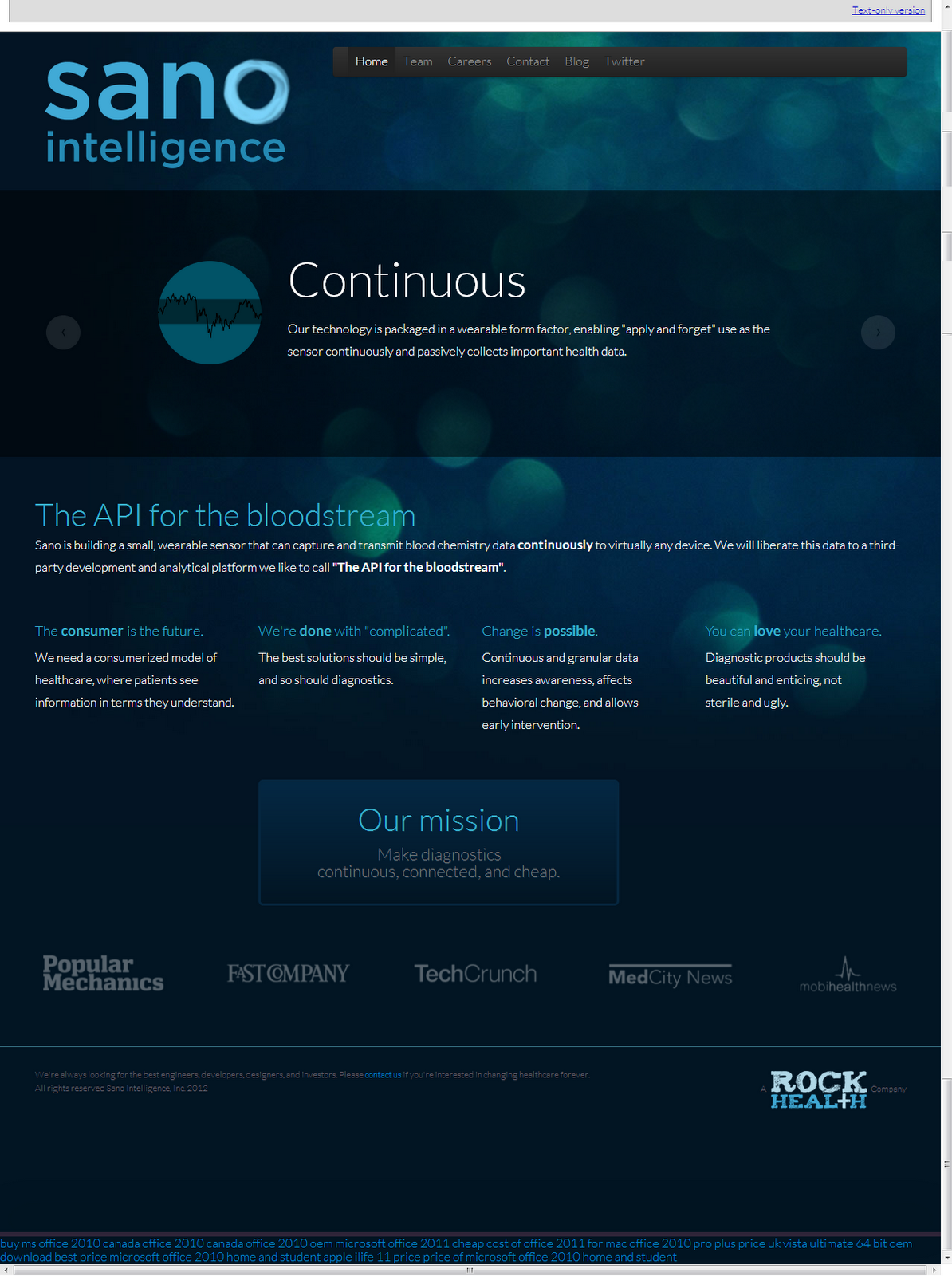
- Will emerging technologies facilitate the collection of data relevant to geriatricians? Let’s face it, I don’t currently feel a burning need for a “small, wearable sensor that can capture and transmit blood chemistry data continuously.” What I need is something that reliably logs behaviors and symptoms, as well as medication use. [Update 10/17/12: Since yesterday Sano Intelligence, whose site my link points to, has removed the basic info on their blood chemistry sensor. But I am including a screenshot of the cached site below.]
- Will Big Data shower doctors with information before we are equipped to triage and act on it? It sounds terrific to send more data to doctors, but we’re currently already suffering from information overload. (I wrote about the trouble with apps sending data to doctors last week.) We first need to develop systems that allow us to act effectively on the information we already have.
The truth is, although I think Big Data offers a lot of potential for population health management, I’m a little worried about how it might play out regarding the care of individual geriatric patients. Each elderly person could certainly generate a significant stream of physiologic, behavioral, and symptomatic data. But often collecting more data from frail elderly patients results in more healthcare, much of which ends up being of uncertain benefit. (Example: more scans usually turns into more things to work up and investigate.)
However, here’s an approach that sounds more manageable to me: a system that would allow doctors such as myself to specify the data to be collected, and that would make this data collection manageable and accurate for patient and caregiver.
In other words, instead of bombarding me with data and telling me to help the patient, what if the patient, the system, and I all first agreed on what information would be useful to gather, and then I received it?
Could I get a nightly confusion monitor for Mr. A please, along with an accurate log of his pain and constipation complaints, a record of medications taken including as-needed medications and over-the-counter drugs, and a daily measure of his physical energy, so I can study his trends and patterns? Please?
10/17/12: Here’s a screenshot of Sano Intelligence’s homepage as it was on 10/10/12, with a little description of the kind of data they could be providing: