• Skip to main content
  • Skip to primary sidebar
  • Skip to footer
  • Home
  • Blog
  • Book
  • About
    • About the Blog
    • About the Author
  • For Family Caregivers
  • Contact
    • Feedback on Apps and Services

GeriTech

In Search of Technology that Improves Geriatric Care

Uncategorized

Dinosaurs Still Roaming: Trying to get medical info from another doctor

November 9, 2012

Remember that case I mentioned earlier this week, where I was trying to coordinate with PCP, neurologist, home health RN, in-home paid caregivers, and the assisted living facility?

Well, I had left out the orthopedic surgeon. He operated on the patient several weeks ago, but I have yet to meet an orthopedic surgeon who is interested in the geriatrician’s recommendations, once the patient is out of the hospital. Besides, seemed to me that the surgeon wouldn’t need to do anything differently based on my findings.

However, I had been hoping to get the hospital discharge summary, to get more data and some details on the patient’s status at that time.

And here’s what has happened so far:

  • I faxed him a note and a release of information signed by the patient’s representative, asking for some specific information (imaging studies, initial consult note, discharge summary for recent hospitalization).
  • Several days later, I get a letter, in the mail, with a copy of my fax, and a note from this ortho practice, informing me that “Effective 10/1/03, any Medical Records Requests regarding the practice’s patients must be addressed and served to :

[Name of Hospital Which Apparently Owns or Is Affiliated With Practice] , Health Information Department, Attn: Release of Information, [Address], San Francisco. Fax # is 415-xxx-xxxx, or to check status, please call 415-xxx-xxxx.

That’s right, folks. I faxed a request for medical information so I could more effectively provide my geriatric consultative care, and I am sent in response a SNAIL MAIL letter, telling me who to mail or fax.

The said snail mail letter was hand-addressed. I am of course wondering why the heck they couldn’t have faxed me back their redirective notice. At least then I could’ve been sitting here irritated a few days sooner, wondering why they aren’t doing me the courtesy of forwarding my request directly to their Health Information Department.

You see now why primary care offices must keep squads of office staff on hand to manage communication? And why it’s invariably easier to order a duplicate imaging study, than to try to wrest the results from another clinician’s office?

I think this story also illustrates why a recent survey of clinician perspectives on health information sharing found that “most consider ‘within 24 hours’ to be a reasonable timeframe for the exchange of information when a patient requires follow-up care or is being treated for an urgent problem.”

My initial reaction was that 24 hours is too long. (Have found myself far too often missing the needed info at the time the patient was sitting in the office with me; that’s when you need to access that discharge summary now, not in 24 hours.)

Now, as I look at this snail mail letter, I can see why 24 hour turnaround might sound pretty good to many outpatient clinicians.

I, of course, want nearly immediate access. This would allow me to do today’s work today. For the patient and family, these means I can do my medical decision-making on their behalf right when they ask me to, instead of saying that I’ll get back to the them (and then we all have to keep track of that unfinished task).

Which existing or promised technologies would enable me to easily access the information this doctor has?

In this case, the gatekeeper for the information is not the physician himself, or his personal office staff. He has delegated (or outsourced) it to the hospital system with which he’s affiliated.

My sending him a personal message through Doximity or Practice Fusion’s new secure clinical collaboration system is not going work.

How about a health information exchange? I know about these in theory but haven’t tried in practice. Just took a look on Google. Apparently we have our own grassroots local HIE in the works: HealthShare Bay Area. Which seems to have been in the works for a few years already. Of course the FAQs provide no information as to when the information might be available, and how a small independent practitioner such as myself would sign up (is this just for the big hospitals to talk to each other? is a small grassroots non-profit really up to this task?)

How about…something where the patient gets to always access his medical information, and can share it with whatever doc he chooses? Not available now, but perhaps in the future?

When will we leave the healthcare communication dinosaurs behind?

Can anyone else recommend a solution that might be actually operable here in SF, say, within 3 years?
Filed Under: Uncategorized

Drive: The Surprising Truth About What Motivates Doctors to Provide Better Care to Elders?

November 8, 2012

I’ve recently started reading Daniel Pink’s Drive, and it makes me repeatedly want to jump up and down shouting “Yes! Exactly!”

It also leaves me repeatedly thinking this:

Everyone pushing for better primary care for elders should read (or reread) this book.

As in:

  • Accountable Care Organizations, the great shining hope for healthcare improvement, who will want better care for elders in order to reduce their financial risk (a rather sordid reason to improve care, but there it is).
  • Quality champions, who are trying to figure out how to rejigger systems so that clinicians do better. (Teach them to work in teams!)
  • Policy wonks, who are very into incentivizing providers these days. (Pay clinicians an extra $10 per member per month! That’ll do the trick!)
  • Healthcare entrepreneurs, many of whom seem to believe that primary care clinicians will be shelling out for their innovations in order to compete more effectively in meeting the demands of empowered and engaged consumers. (Hello? Have you heard of the primary care provider shortage in Massachusetts?)
  • Concerned patients and caregivers, who are certainly right to demand better care, and will need engaged and motivated clinicians with whom to forge fruitful collaborations. (Your doctor is probably not going to feel like being more helpful to you because she gets dinged by her ACO when the quality metrics don’t pan out).

For those who haven’t read Drive or aren’t familiar with the basic premise, this is a book that summarizes a recent evolution in how psychologists understand what motivates individuals.

Basically, people used to think that individuals were motivated by essential biological drives (survival, procreation, etc) and then also by rationally responding to extrinsic factors such as rewards (i.e. money) and avoidance of punishments (i.e. fines).

However, psychologists eventually noticed that people often engaged in behaviors for which there was no obvious benefit, other than the enjoyment of engaging in the activity. And in some cases, this activity led to very significant, important products, such as Linux (open-source software) and Wikipedia.

This third drive has been called intrinsic motivation. My guess is that if you are reading this post, you’ve probably already heard about this drive, and maybe even come across some of the literature that suggests that in physicians (a group in which many start with high intrinsic motivation to do their work), use of external motivators may damage intrinsic drive (see here & here).

So my question to all is, if we know about this third drive, then why are most of the suggestions for improving primary care (which should be the foundation of good care for frail elders) rooted in manipulating extrinsic motivators?

Here’s a quote from Pink:

[Organizations] continue to pursue practices such as short-term incentive plans and pay-for-performance schemes in the face of mounting evidence that such measures usually don’t work and often do harm.

Pink goes on to define work as algorithmic (follow a set of instructions) versus heuristic (experiment with possibilities and devise a novel solution). 

Which do you think requires more intrinsic motivation? That’s right, heuristic work.

And does providing comprehensive, compassionate, collaborative care with a medically complex patient and his or her family sound like an algorithmic task to you, or a heuristic one?

This to me, is a no-brainer. Obviously there is much medical care that can and should be done by algorithms.

But not all medical care can be done algorithmically, especially when patients are elderly, complex, embedded in a care circle, and require personalized care and shared decision-making. 

To have quality medical care for elders, primary care providers should be doing complex collaborative problem solving with the patient and family.

That’s heuristic work. That requires intrinsic motivation.

So every time you come across some system, tool, or technique for improving primary care, I suggest you ask yourself:

“How can we use this is a way that improves the clinician’s intrinsic motivation, or at least doesn’t snuff it down too much?”

We should also be talking about how to bolster and support clinicians’ intrinsic motivation to work effectively with patients. Remember, over 50% burnout in front-line clinicians in a recent survey. Unless you truly believe it’s possible to have quality primary care for elders without engaged clinicians, something must be done.

Speaking of what should be done, Cassel and Jain published a Viewpoint in JAMA this past summer which addresses some of the above:

Those advancing physician-level interventions are looking to change how physicians do their jobs. A more global approach—in keeping with more attention to intrinsic motivation—would be to change how physicians perceive their job. Physicians who are satisfied with their work lives provide better care….To reach sustainable quality goals, however, close attention must be given to whether and how these initiatives motivate physicians and not turn physicians into pawns working only toward specific measurable outcomes, losing the complex problem-solving and diagnostic capabilities essential to their role in quality of patient care, and diminish their sense of professional responsibility by making it a market commodity. Rewards should reinforce, not undermine, intrinsic motivation to pursue needed improvement in health system quality.

Ok. I’m going to be thinking about intrinsic motivation as I think about implementing tech and systems to improve geriatric care.

Btw, yours truly is writing this blog on her own time, for no money. Intrinsically motivated 🙂

Filed Under: Uncategorized Tagged With: Drive, geriatrics, primary care

Communication for Care Coordination

November 6, 2012

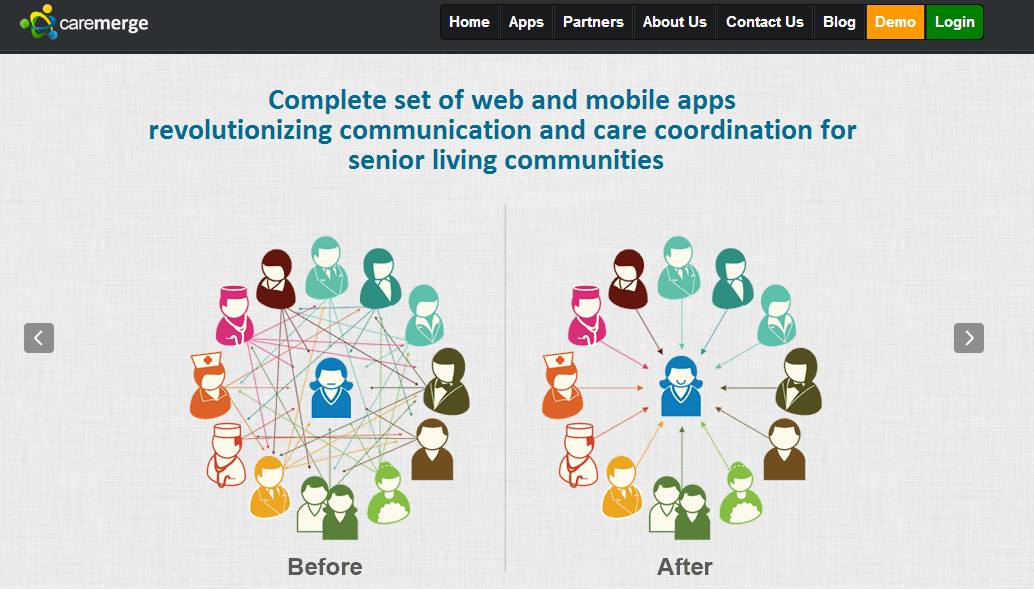
Ok, what do you think of the “after” graphic on the right, above? (It’s from the Caremerge website.)

Me, I think it looks more organized and soothing than the “before” graphic. But it conveniently glosses over the truth that in fact, those many people surrounding the patient/resident do need lines of communication between them, and those lines need to be easy, open, and effective.

Last week, after a follow-up phone consultation with the family of a patient in assisted-living, I completed my charting and then directed my cloud-based EHR to fax copies of my note to the other involved providers.

It took longer than the charting did, since my EHR, MD-HQ, only allowed me to fax to one recipient at a time. So I wrote to my support person, asking if there was some way to fax multiple recipients in one fell swoop.

“How often do you see yourself needing to do this?” he wrote back.

“Often,”was my answer. “I just faxed to:

PCP
neurologist
home health agency
home caregiver agency
residential facility.”

This is not an unusual situation when one cares for a geriatric patient (plus there’s usually family and others in the unpaid care circle to communicate with too). Not only do we need power tools for medication reconciliation and all other in-visit clinician tasks, but we have power communication needs as well.

The good news for me personally is that MD-HQ is a small nimble company, so my support person is the lead developer. He’s now updating my EMR, and it should soon be much easier for me to send a fax update to the many other providers I’m often coordinating with. (Thanks Ben!)

Still, even with faster faxing to multiple people, the coordination and communication feels hard for this day and age. And such a pity to rely on shooting pictures of text to each other, since those pictures do not usually turn into searchable text in the recipient’s EHR.

When it comes to communicating, in medicine we are often using methods that feel distinctly clunkier and outdated than the technology we use in our non-professional lives. (If only Gmail were HIPAA secure and I could see my messages back and forth, properly bundled into conversations! Except I also want it to seamlessly connect to my EHR. Too much to ask, for sure.)

Any relief on the tech innovation horizon? Well, I haven’t yet had the opportunity to try anything myself, but I’m certainly interested in whatever other clinicians have found works.

By the way Caremerge, a product designed for assisted living facilities, apparently offers a “clinical collaboration app,” in order to “bring all offsite stakeholder together to collaborate and help make faster better clinical decisions for the residents.”

I guess in my patient’s case, the “offsite stakeholders” would be me, the PCP, the neurologist, the home health care RN, and the private in-home caregiving agency.  Hm. I’m certainly willing to try working with something like Caremerge, but admit I’m a little reluctant to have to rely on an assisted living facility’s technology to communicate with a patient’s many other providers.

Besides, I need options for when a patient isn’t residing in a facility using Caremerge, or another facility-based communication platform.

Right now my preference would be some kind of secure messaging solution that feels like the email of today (rather than like the email of 1999). Preferably it would not be embedded within some comprehensive care management platform or EHR, because an independent physician like me is likely to work with other providers who are each using a different platform. I’ve recently tried ZSentry but doesn’t seem good for more than the one-off secure missive. (I need secure back-and-forth with multiple recipients. You know, like real email.) [Note added 11/17: Zsentry subsequently contacted me to provide additional information on how the service works. For the record, it does allow secure back-and-forth with multiple recipients. I’m still trying to figure out how easy it is to view previous messages sent as part of the conversation, etc.]

So, I’m open to other suggestions, if readers care to share.

Specifically, I’m looking for a secure communication solution that:

  • Is EHR and platform agnostic.
  • Is supportive of ongoing communication with multiple providers
  • Allows one to easily track what information has already been exchanged (the conversation view in Gmail works for this, until someone changes a subject heading).
  • Bonus points if it’s easy to forward the exchange when yet another provider gets involved.
  • Double bonus points if it’s easy to get upload/download to/from a EHR.

We’ll certainly need versatile communication solutions if we are to collaborate effectively, in the way that patients and families expect and deserve.
PS: For more info on what regular primary care practices are facing when it comes to coordinating care for complex patients, this AHRQ white paper from Jan 2012 struck me as a good summary.

Addendum 11/7/12 
A friend suggested I try Doximity.com. Just signed up, which was easy (impressive how they found my pic on Google and proposed it to me; talk about minimizing the work!).

I guess I could use it to communicate with the PCP and neurologist (who are not on, but I could invite them).

But this wouldn’t allow me to communicate with home health RN, private caregiving agency, and assisted living facility.

Bummer. I’d like to find a communication solution that allows me to easily loop in the non-physicians.

Filed Under: Uncategorized

3 key points learned in a month of GeriTech

November 1, 2012

It’s now been a month since I started documenting my search for technology to improve geriatric care on GeriTech. During these past several weeks, I’ve watched some keynotes from recent big health tech conferences, started following clinicians and health techies on Twitter, met some like-minded clinicians in person and online, connected with some entrepreneurs in the health tech space, and reviewed some of the relevant peer-reviewed literature.

Here’s are three key things I’ve learned so far:

1. Healthcare tech is a hoppin’ space!

Lots of energy, lots of people, and a fair amount of money and entrepreneurial energy seem to be in healthcare tech. Recent big conferences included Health 2.0, the New York eHealth Digital Health Conference, the Wired Health Conference, the Strata Rx conference (that one is data-focused), and the Wireless Health Conference. They all seem to be combining technology, business, and a hefty dose of consumer-driver healthcare, with a variable amount of policy. Insurance companies are often partners, and sometimes their CEOs are featured as keynotes, which makes sense I suppose since big payers are big players in this arena. Some foundation support is present, especially RWJF.

On another front, the Digital Health group on LinkedIn has 13,348 members (now including yours truly), with multiple ongoing discussions and polls. A little over 1,100 appear to be physicians, although it’s hard to tell how many of them are practicing docs or academics, as opposed to physicians in industry and business.

2. There is interest in the aging space, but it’s probably not the focus of most healthcare tech innovation.

Boomers are a “large market”, and I’ve seen AARP involved in several events (including their own health tech innovation event, which I commented on here). I’ve also come across countless companies and products for aging-in-place, and connected with Aging 2.0, a group dedicated to fostering innovation for the 50+ market.

That being said, my impression so far is that most of the innovative energy is directed towards products for a younger, medically less complex population, and here’s why:

  • Private insurers are interested in saving money, and possibly also in looking hip. Boomers will be increasingly covered by Medicare, which is much less nimble when it comes to adopting new tech, decidedly less interested in seeming hip, and perennially bedeviled when it comes to saving money.
  • Healthcare tech innovators are understandably thinking of the business case when they design products. In general, seems a business case is easier to make when targeting a younger population who presumably will pay out-of-pocket, or use HSA money, or have their employers pay, or perhaps have their hip insurance companies pay.
  • For obvious reasons, it is WAY easier to design a product for younger less medically complex people. My own patients not only are medically complex, but also ideally would be offered products that accomodate vision problems, less flexible fingers, less flexible minds, the involvement of caregivers, etc. All this means that healthcare tech innovations for the elderly are a much tougher design proposition.

3. There seems to be an information and culture gap between academic experts in geriatrics, and the world of healthcare tech innovation.

Last May when I went to the American Geriatrics Society meeting, there was a talk on new innovations in technology. It was given by a non-clinician industry insider. Nothing wrong with this per se, but I do think this illustrates our relative uninvolvement in this big booming world of healthcare tech. Most likely this is because academics live on the grants-and-publication schedule, which every year is falling further behind the pace of healthcare change in the real world.

Meanwhile, here are a few telling statements I’ve heard since starting GeriTech:

“I don’t know what [integrated patient portals] are. Are they portals that give patients access to the EHR as in Open Notes?” — Academic physician & Ivy league professor, currently involved in a project of improving health care for seniors

” I am a bit of a professional techno skeptic but I am sure that
eventually it will become really and truely helpful.” — A program
director at a prominent foundation dedicated to improving the health of
older Americans.

“More care, less technology.” — Goal #3 of the Hasting Center’s Over 65 project.

Onwards and thank yous

I have a fair streak of techno-skepticism myself, but as I continue to believe that the right use of technology is critical to effectively and sustainably meeting the healthcare needs of America’s elders, I’ll be continuing to explore this space for the foreseeable future.

Clinicians, you’ve generally been pretty quiet so far, but I hope eventually to persuade some of you to contribute. Please consider:

  • explaining a clinical problem that might benefit from a tech solution
  • sharing a useful tech solution that you’ve found
  • commenting on anything tech and geriatrics that you come across
  • having me interview you (then you don’t have to write anything yourself)

Last but not least, a shout-out to some of the people who’ve helped me get going this past month:

Wen Dombrowski, MD and a geriatrician, social media maven, and healthcare tech connector who has been key to introducing me to the healthcare tech community.

Eric Widera and Alex Smith, MDs and founders of Geripal.org, who encouraged me to take these next steps into blogging and Twitter.

Christopher Langston of the John A. Hartford Foundation, who posted the very first comment on GeriTech.org, and encouraged me to keep going.

Julie Menack, geriatric care manager and aging-in-place tech maven, for giving me ideas on what to learn more about.

Mark Phillips, product manager at GE Healthcare IT, who noticed this blog early on and appreciates the perspective of working clinicians.

Jim Sabin, MD and an organizer of the Over 65 project, for his interest in this project and in learning from each other.

There are of course more, but I do have to get back to my day job now. If you’re still reading, thanks for your interest in Geritech.org, and I hope to hear from you soon!

Filed Under: Uncategorized Tagged With: healthcare technology

Micropractices, IMPS, and Improving Primary Care

October 30, 2012

This past weekend I attended my first IMP Camp. IMP originally stood for Ideal Micro Practice, but now stands for Ideal Medical Practice.

I went because after years of being an ardent supporter of team-based primary care, I decided last spring to switch to practicing geriatrics in a solo micropractice.

This is a career development which I still consider with mild surprise. I was after all (and continue to be) a huge fan of Tom Bodenheimer’s work proposing that primary care should be delivered by high-functioning teams, rather than by overwhelmed clinicians trying to do everything themselves.

However, finding a high-functioning team to join is not so easy. Part of the problem is the still-predominating fee-for-service payment system, which generally doesn’t reimburse medical work that isn’t provided face-to-face and by a “billable provider” (i.e. physicians, NPs, PAs, but not RNs). This can really cripple outpatient geriatric care, which I believe ideally would involve plenty of phone follow-up, care coordination, and nurse-led coaching interventions.

Of course we now have a move towards accountable care organizations (ACOs) and value-based payments, but it’s not yet clear how this trend will mean for the experience of the average on-the-ground primary care clinician. (Will ACOs be yet another stakeholder complaining about what we didn’t do? Or will they lead to substantive support in helping us do our work well?)

Furthermore, even when funding mechanisms support a team-approach to primary care, one still needs the team to be high-functioning. As most people who’ve worked on teams can tell you, not all teams work well. This is especially true in primary care, where healthcare providers may be asked to take on very different roles without getting adequate coaching and support in making the requested changes. (To his credit, Bodenheimer is well aware of the rhetoric-reality gap when it comes to teamwork.)

What’s a clinician to do when she wants to provide high quality outpatient care but is worn out by primary care as usual?

My answer — for now — is to try an independent micropractice. The micropractice is the brainchild of Dr. Gordon Moore, a family medicine doc who realized that by leveraging technology to strip his practice setting down to a minimum of staff (as in, none) and overhead, he could practice better primary care. Better, as in, his patients were happier and he was happier. In particular, Moore found that this model:

  • Improved access, leading to better care and better patient satisfaction. Being the only one answering the phone means a clinician can respond quickly to patient requests, and is always in the loop.
  • Allowed more attention to direct patient care. A small lean practice requires less management and coordination, especially when technology is effectively leveraged to handle administrative work.
  • Facilitated longer patient visits. The average primary care practice spends 50% of revenue to cover overhead. Less overhead means less need to pack in revenue-generating visits every day, which means a clinician can earn a decent salary while giving patients longer visits (often resulting in higher patient satisfaction, provider satisfaction, and better care).

This last point, however, is what makes many primary care wonks nervous. Longer visits may mean happier patients, but if a clinician can make a living caring for a smaller patient panel, many start to worry about exacerbating the looming shortage of primary care providers.

Still, the micropractice model in many cases has led to macrosatisfaction for patients and physicians, and that is no trivial thing.

In fact, in listening to Gordon present this past weekend on the key tenets of Ideal Medical Practices (he has very sensibly broadened the IMP term and focuses on what constitutes ideal outpatient medical care, rather than on micropractices per se), I was struck by how well the IMP concepts dovetail with what I hear patient/consumer advocates saying they want.

What I see patients/consumers clamoring for, and how the IMP model meets the need:

  • Access: they want to be able to reach their healthcare provider promptly, as needed.
    • IMPs offer excellent phone access and usually open access scheduling.
  • Relationship: they want to feel that the healthcare provider knows and understands them, and they want to be able to work with a compatible provider repeatedly.
    • IMPs prioritize the patient-physician relationship; in small IMPs almost all patient needs are met by the patient’s usual provider.
  • Patient/consumer centered care: they want the healthcare to be organized around their priorities, and not just what the provider, or healthcare system, thinks should be the priorities.
    • IMPs emphasize care that is driven by the patient’s needs, goals and values. Many use the “How’s Your Health?” online questionnaire to regularly provide clinician’s with the patient’s self-assessment of health and needs.
  • Technology: they want healthcare providers to communicate via email and other new technologies, and to keep up with emerging technologies that might improve health and care coordination.
    • Virtually all IMPs use technology to maintain a high-efficiency/low-overhead practice. Most IMP providers are available to patients through some form of messaging.
  • Coordination: they want their primary healthcare provider to communicate, connect, and coordinate with other providers. 
    • Technology often facilitates this.
  • Support in self-management: they want providers to help them feel empowered and confident in their ability to self-manage their health.
    • By leveraging a collaborative relationship, a focus on patient-centered care, and technology, IMPs are generally able to successfully address this need.

In short, IMPS generally offer a smaller intimate practice setting which is well-suited to providing the close and collaborative patient-physician relationship that historically has been the foundation of good primary care. Just as many of us enjoy patronizing smaller local businesses, especially if we get to know the owners, patients often enjoy a smaller independently owned practice.

So if patient engagement really is the “blockbuster drug of the century,” as David Chase proclaimed in Forbes magazine last month, then IMP practices should certainly be on the radar of those looking for high-quality primary care.

What about team-based patient-centered medical homes? Well, those are a good concept too, but transforming practices may take some time. (You can read about lessons learned from the National Demonstration Project here.)

In the meantime, yours truly is trying out the micropractice/IMP model for herself, and will keep you posted on how it goes. Fortunately for me, the IMP community is largely focused on providing practical assistance to other clinicians trying to start or maintain IMP practices, so I’ve been getting some much appreciated support and advice. ((Disclosure: the IMPs have formed a nonprofit group, and I paid to become a member last April, which gives me access to some members-only informational resources.) I’d certainly heartily endorse this creative and spunky group to other clinicians contemplating a similar practice shift. Thanks IMPs!

 
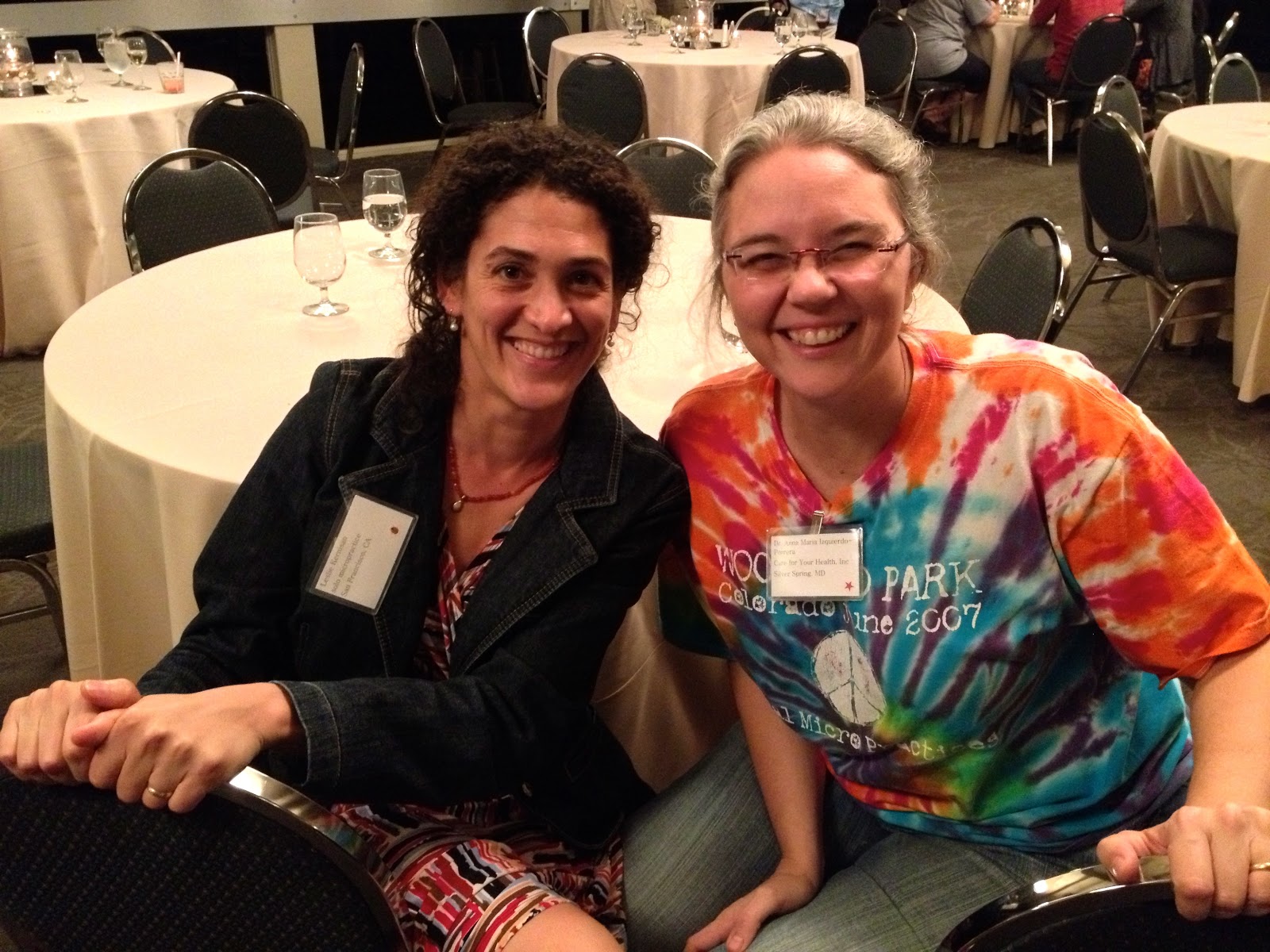
Me with Dr. Anna Maria Izquierdo-Porrera, a geriatrician with an amazing practice in Maryland (www.care4yourhealth.org)
Dr. L. Gordon Moore, who is now doing really fascinating work for Treo Solutions (negotiating improved payment models with big payors). Who wouldn’t listen to a man in tie-dye?

Filed Under: Uncategorized Tagged With: patient engagement, primary care

  • « Go to Previous Page
  • Go to page 1
  • Interim pages omitted …
  • Go to page 19
  • Go to page 20
  • Go to page 21
  • Go to page 22
  • Go to page 23
  • Go to page 24
  • Go to Next Page »

Primary Sidebar

Get the ebook!

Follow @GeriTechBlog

Featured Posts

GeriTech’s Take on AARP’s 4th Health Innovation @50+ LivePitch

My Process for Meaningful Use & Chronic Care Management

Aging in Place Safely: Dr. K vs APS vs the latest start-up

Recent Posts

  • Smartwatches as Medical Alert Devices
  • Putting Older Adults at the Center of Technology Conversations
  • Using Technology to Balance Safety & Autonomy in Dementia
  • Notes from the Aging 2.0 Optimize 2017 Conference
  • Interview: Upcoming Aging 2.0 Optimize Conference & Important Problems in Need of Solutions

Archives

Footer

Creative Commons License
This work is licensed under a Creative Commons Attribution-NonCommercial-NoDerivs 3.0 Unported License.
Based on a work at geritech.org

Copyright © 2026 · Leslie Kernisan, MD MPH