• Skip to main content
  • Skip to primary sidebar
  • Skip to footer
  • Home
  • Blog
  • Book
  • About
    • About the Blog
    • About the Author
  • For Family Caregivers
  • Contact
    • Feedback on Apps and Services

GeriTech

In Search of Technology that Improves Geriatric Care

Uncategorized

4 common senior health problems that need solving

January 9, 2013

I noticed a few weeks ago that Brian Quinn over at RJWF Pioneer was asking for problems for the holidays. Apparently he is frequently approached by people with solutions, not with problems.

I wish he and I could switch places for a few weeks. You want problems? I’ve got problems, going up the wazoo (not my own, fortunately) and out the ears (which I do look in; lots of older people hear better once that wax is removed).

For instance, in my last post I mentioned some very common problems that I’ve discovered among most of my patients, even among my wealthy white educated Medicare patients.

In this post I’ll clarify these problems a little bit more, and share some thoughts on some approaches that I can envision helping solve each problem. (Hint: I can see a future for tech solutions here.)

Disclaimer: These are big complicated problems. I briefly list a few reasons why they happen, but this obviously can’t be comprehensive. (There’s a reason why expert workgroups produce such long reports.)

Real problems of real elders (whether wealthy or not)

  • Prescription of medications that cause confusion and worsened balance in seniors (and may increase the risk of developing dementia: see here and here). 
    • Why it happens:
      • Many common prescribed (and OTC) medications are “psychoactive”. These are the ones that usually come with warnings to not drive or operate machinery.
      • Most doctors know, when asked, which medications have these side-effects, but they underestimate how likely it is that an older patient will be affected.
    • What could help:
      • An app or other service that helps patients and caregivers quickly figure out whether a prescribed medication is on the Beers Criteria. This is a list of 34 medications and types of medications that are “potentially inappropriate” for older people, and was last updated in 2012.
      • A Beers Criteria App exists for healthcare providers, but I haven’t found one yet for patients and families.
      • The app should provide guidance on how to constructively engage providers when an potentially inappropriate medication is prescribed. The American Geriatrics Society offers suggestions here.
      • Most important is that the app make it super easy for patients to enter the medication name into the app. Has anyone yet developed a way that patients can take a picture of the prescription bottle, or barcode, or QRS code? (I’m so tired of medication apps that require people to laboriously type in medication names — huge usability killer.)
  • Dementia that goes undiagnosed for far too long; once diagnosed, inadequate education and support for family caregivers
    • Why it happens:
      • PCPs are too busy; they have too much to do, and far too little time.
      • Many PCPs are uncomfortable doing cognitive screening, both because they haven’t done it often and because they aren’t sure exactly what to do with the results (nobody likes to open a can of worms).
    • What could help getting diagnosis started:
      •  Cognitive screening is now supposed to be part of Medicare’s annual wellness visit. A suitable app could help patients and caregivers be proactive in gathering practical information prior to the visit. This should include a questionnaire on ability to manage IADLs independently; problems with IADLs are a good sign that further cognitive evaluation is needed. One could also include a short questionnaire based on something like the Alzheimer’s Association’s 10 signs.
      • I currently find no app available to help patients and families prepare to bring up a concern of cognitive impairment to a clinician. Does anyone know of one?
  • Lack of care coordination among multiple specialists and care sites
    • Why it happens:
      • Many reasons, including siloed information, not-yet-widely-compatible HIT systems, clinicians unused to having to coordinate with others and share information.
      • Those patients and families who are willing to keep their information and move it with them have found it hard to obtain and organize their information. (I’m eager to see if the new Blue Button output will help.)
    • What could help:
      • This problem’s too big to address in this post. Eventually we’ll have better personal health records and health information exchange.
  • Inadequate understanding of overall health status, health trajectory, and prognosis
    • Why it happens:
      • Many reasons; generally clinicians are lacking the time, comfort, and sometimes experience in addressing the “big-picture” with patients and families, especially if that big picture isn’t looking so rosy.
    • What could help:
      • Clinicians need a lot of training and support in order to do their part. Apps and programs are sorely needed to help calculate life expectancy, likelihood of dying in next few years, etc. Right now it takes a lot of work to get the right data right now; imagine if clinicians could instead ask Siri (or IBM’s Watson). Then they could focus on the task of sharing the info with the patient (this is hard, and before especially tough talks I still review something like the Fast Facts for Palliative Care, or Uptodate).
      • While we wait for millions of clinicians to get more training: it would help if patients and families could be coached in how to ask their providers to address big-picture issues, by regularly saying things like “How do you expect my overall health and function to evolve over the next five years?” Or “How important is managing this condition, in the overall context of my loved one’s health?” (This is when we can opt to not do routine cardiac testing in the dementia patient who is peeing blood and losing weight — true story from several years ago! We really need to help both clinicians and families see the forest before addressing the trees.)
      • Coaching and patient education interventions have been developed and tested; the issue is making them more widely available and usable for patients and families.

Ok, I will list ideas for addressing the second half of my list in my next post.

In the meantime, if any clinicians or others have ideas on how to address the above problems, please comment or email me.

In a nutshell

Even wealthy educated older adults repeatedly suffer from certain pervasive problems in outpatient healthcare. These include the prescribing of risky medications, late diagnosis of cognitive impairment, lack of care coordination, and inadequate understanding of overall health status and prognosis.

In this post, I briefly summarize some key causes for these problems and some ideas for addressing them.

I’d love to be pointed towards any practical tools or technologies that can help clinicians, patients, and families address these issues. 
Filed Under: Uncategorized Tagged With: geriatrics, primary care, problems to solve, tech for clinicians

Technology, Innovation, Disparities, and the Elderly

January 7, 2013

Won’t tech tools worsen health disparities in the U.S.?

This is a concern I’ve heard more than once from my colleagues in academia. (If you’re not an academic and aren’t sure what health disparities are, here’s a handy summary from healthypeople.gov. Note that healthypeople.gov doesn’t call out the elderly as prone to suffer disparities, but MedLine does.)

It’s an understandable worry. After all, here are some common predictions I hear from the digital health community:

  • Smartphones, tablets, sensors, and apps will allow people to collect and monitor their own health data
  • Better access to information will allow people to make better health decisions, and will empower them to direct their own health care

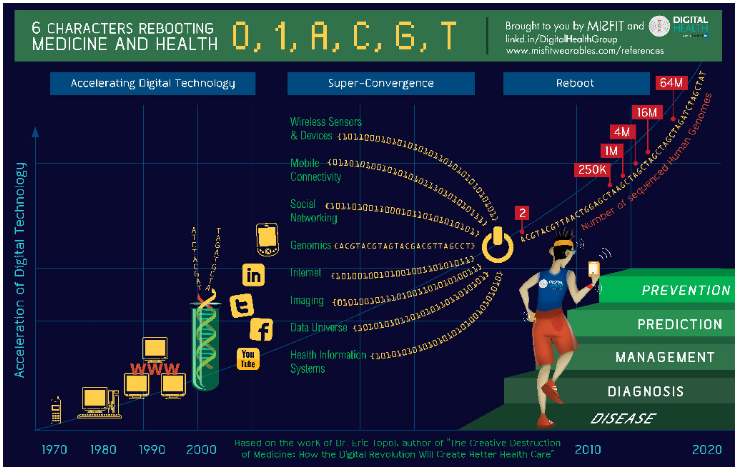
Or take a look at this Digital Health Infographic, created by Paul Sonnier who runs LinkedIn’s huge Digital Health Group:

Obviously, if you’ve spent any time providing clinical care to people who are poor, less educated, or elderly, it can be hard to imagine them donning a sweatband, digitizing themselves, and hustling up the self-empowerment stairs to a wonderful healthy future. (Where the heck are the people who have multi-morbidity or advanced chronic illness in this infographic, anyway?)

If better health will come through smartphones, tablets, and apps, then what happens to the health of those who can’t afford to purchase them, or don’t find them usable?

If better health comes to those who effectively use the internet and their own personal data to chart a better course for their own health, what happens to those who can’t access this information, or can’t sort through it effectively?

The median household income in 2011, according to the Census Bureau, was $50,054. IRS data from 2010 shows that to be in the top 50% of income in the U.S., you only need income of at least $34,338. To be in the top 25% corresponds to income of $69,126 or more. To be in the top 10% = $116,623 or more; to be in the top 5% = $161,579 or more. (And in case you are wondering how much income was required to be in the fabled 1% in 2010, it was at least $369,691.)

Also well known in academia: studies consistently show that both lower socioeconomic status and increased age correspond to greater disease burdens and worse health outcomes.

So in summary, we have technological innovations on the horizon, which is predicted to improve the health and wellbeing of those who can afford them and know how to use them — a group already advantaged by affluence and generally good health.

Will these tech innovations worsen disparities?

Maybe. It would really depend on the circumstances. Specifically, disparities would be increased if:

  • The tech innovations actually meaningfully improve health outcomes.
  • The innovations don’t become available to people of more modest means, lower health literacy levels, or different cultural backgrounds.

However, if tech innovations improve outcomes AND become available to a broader swath of the population, then disparities could potentially decrease a bit.

This doesn’t seem far-fetched to me. There certainly is a digital divide in the country, both along age lines and along socioeconomic lines, but the price of technology is dropping and access is increasing. Health insurers may also be willing to subsidize use of new technologies, if health benefits are clear.

Should improving quality be a higher priority than reducing socioeconomic disparities?

My own answer to this question is definitely yes, especially when it comes to the elderly.

This is because even Medicare beneficiaries who are wealthy, white, and educated often suffer from crummy healthcare.

What do I mean by crummy? Here are some examples of problems I routinely discover in older people of higher socioeconomic status (you’ve probably come across them when it comes to healthcare for your parents or grandparents):

  • Prescription of medications that cause confusion and worsened balance
  • Dementia that goes undiagnosed for far too long; once diagnosed, inadequate education and support for family caregivers
  • Lack of care coordination among multiple specialists and care sites
  • Inadequate understanding of overall health status, health trajectory, and prognosis
  • Lack of non-pharmacological treatment for conditions such as depression, gait instability, pain, incontinence, and dementia behavior management
  • Procedures and diagnostic evaluations of unclear clinical benefit
  • Lack of clarification of values, goals, and care preferences
  • Inadequate symptom monitoring and management, including inadequate pain management
  • Frustration and confusion with the healthcare system

I could go on, but I’ll stop there for now and go back to socioeconomic disparities and improving health quality.

We should definitely keep working on reducing health disparities due to socioeconomic status. The rich will always end up better off than the poor, but given the overall wealth of the US, people in this country should have pretty good health care at all levels of economic status.

However, the fact that even wealthy white educated Medicare beneficiaries suffer from poor health care is sobering. If the system can’t do right by them, how can it hope to do right by the middle class, and lower middle-class? (The truly disenfranchised, such as those suffering from extreme poverty or severe substance abuse, will likely need special resources tailored to their needs.)

So as part of a multi-pronged strategy to improve the healthcare of older adults, it’s valuable to look to the new tech tools and figure out which can help our more advantaged older patients with multiple chronic diseases. Once we’ve made headway on that challenge, we can work on disseminating effective tech tools to those with less income, or adapting them for people of lower educational levels or different cultural backgrounds.

Even if disparities remain, if every section of society has at least moved upwards in health quality, we’ll be better off.

In a nutshell:

Many digital health innovations are most likely to be used by people who are younger, more affluent, and more educated. One can legitimately worry that these innovations will worsen health disparities in the U.S.

However, for innovations to significantly worsen disparities, they would have to both meaningfully improve health outcomes, and not be made available to people of lower economic status. Although the digital divide is real, access to digital tools is increasing for almost all levels of society. Payers may also eventually subsidize tools that have been shown to improve outcomes.

The Medicare population is one in which many suffer from inadequate health care, even when they are wealthy, white, and/or educated. Improving healthcare for older adults requires a multi-pronged strategy, and part of that strategy should be to identify which new digital health tools can improve care in those older adults who are able to access them.

Once suitable tools are developed and identified, additional efforts will be needed to disseminate and adapt them to a broader group of older adults, including those with lower incomes, lower health literacy, and of different cultural backgrounds.

(Disclosure: I have recently opted-out of Medicare — see last FAQ for why — and now only treat people who are more “advantaged.” I admit that I need to believe that by piloting an alternative model of outpatient geriatric care and trying out new technologies with my patients, I’m still serving the cause of better healthcare for all older Americans.)

Filed Under: Uncategorized Tagged With: healthcare technology

Resolutions for 2013

January 2, 2013

A little goal-setting can be a good thing. Here are a few for me this year:

1. Have another clinician write a guest post. As fun as it’s been to monologue away, I’d like to get a few other people’s perspectives on the blog. The goal is, of course, to foster thoughtful discussion on how technology can improve the care of older adults, from the perspective of clinicians with practical experience in providing health services to older adults.

2. Find a decent medication list application that I can recommend to patients and families. My biggest priority is that the app help patients keep track of *everything* that has prescribed by multiple providers, including hospitals and EDs. It also should list over-the-counter meds and supplements. (For more on why keeping track of medications is so important, see this post.)

– The must-have feature: medication entry (name and dosing instructions) that does NOT require laborious typing entry for most medications.

– Also required: app cannot be dependent on a single pharmacy chain or EMR system. Many of my patients change pharmacies or use multiple pharmacies. And most of them see providers in different health systems.

– Bonus points if it allows patients/providers to list the purpose of the medication — imagine if every patient understood the purpose of every medication prescribed to him or her!

– Additional bonus points if the app keeps a history, including discontinued medications.

Note that I’m not looking for this app to serve the function of daily reminder (in part because so many of my patients use medisets). This is a nice feature, but my greatest need is to quickly see what the patient is supposed to be taking. I also want to know what the patient is actually taking, but for that purpose, I prefer to see the bottles themselves and be able to use a tool to help with medication reconciliation.

3. Shorter blog posts. Time for me to get better about being concise. Well, for January at least.

There is of course much more that I hope to do and learn in 2013 (so many interesting changes and innovations, so little time), but as far as resolutions go, these three will have to do.

In a nutshell:

This year I resolve to score a clinician-written guest post, to find a medication app worthy of recommending to patients, and to write shorter blog posts (for at least a short while).

If you’ve come across a medication app that might meet my needs, please comment or email me.

Onwards!

Filed Under: Uncategorized Tagged With: medications

Summarizing GeriTech in 2012

December 31, 2012

Today is not only the last day of 2012, but also marks the three month anniversary of the GeriTech blog. This is the 36th post, all written so far by your faithful practicing geriatrician (atypical practice, to be sure, but real practice nonetheless).

So it seems like a good time to look back at what’s been posted, and try to summarize what this blog is about.

I’ll admit that when I launched this blog, it wasn’t with the intention of being the sole author. I was rather looking forward to hearing about what technologies other clinicians had found to be helpful in the care of older adults.

However, so far the clinicians have been rather quiet on the blog (although they tell me very interesting things about technology when I talk to them in person, and I hope to get some of this on the blog in time).

For now, GeriTech = Leslie Kernisan’s professional interests, and hence reflects my personal priorities, interests, experiences, and discoveries about innovation and the future of healthcare.

Here’s what this specifically means:

Geritech is about addressing the nation’s most important healthcare question

No false modesty here! This blogger believes that her interests dovetail with the most important healthcare question facing the country, which is this:

How can we, as a society, provide effective compassionate healthcare to an aging population, at a financial cost that the nation can sustain?

(Do you disagree? Post a comment asap.)

Better primary care for older adults is the answer

The answer to the question above, of course, is that we must meaningfully improve primary care for older adults. This is a no-brainer conceptually. First of all, it’s what patients say they want: to receive care that is comprehensive, coordinated, person-centered, prevention-oriented, as upstream as feasible, and as outpatient as possible. Second, it’s what is cost-effective, compared to managing health problems later when they become health crises requiring hospital care.

(Again, if you disagree with the above, I’m eager to hear your case.)

Just about everything I’m professionally interested in tracks back to this essential issue: how to support and implement better primary care for older adults.

The problem is that it’s very hard to figure out just how to improve primary care for older adults. Still, it must be somehow done.

GeriTech’s key points and discoveries so far

All in the service of fostering better care for medically complex older adults, here’s what I’ve found myself saying on GeriTech:

  • Doing my clinical job is much harder than it should be. Care coordination is time-consuming. Important information takes ages to pry out of hospitals, specialists, and Quest Diagnostics. It’s hard to find patient education resources for crucial geriatrics problems such as delirium, or tapering dangerous benzodiazepines. Medication reconciliation is labor-intensive and error-prone. No wonder it’s hard to provide quality primary care to older adults.
  • Managing the health needs of older people is about much more than prevention and lifestyle. I’ve been genuinely surprised at how much emphasis some leaders in healthcare innovation (like Robert McCray of the Wireless- Life Sciences Alliance, or TEDMED’s Managing Chronic Diseases expert team) have put on prevention and lifestyle changes. Many older adults — namely the ones who generate significant healthcare costs — need much much more: they need help actively managing their multiple chronic diseases and their significant symptom burden.
  • Most tech tools seem poorly suited to improving the health care of older adults. As far as I can tell, most tools are not designed for use by clinicians caring for complex older patients with multiple medical problems. This is a big problem, as we really need effective tech tools that do one or more of the following: 
    • 1) help clinicians like me do our work better, faster, or more thoroughly; 
    • 2) help patients and families do their healthcare work better, faster, or more thoroughly; 
    • 3) support the collaboration between clinicians, patients, and caregivers. 

I posted a list of likely obstacles to senior health tech innovations here.

  • Effective tools for older adults should be developed with the help of practicing generalist clinicians and geriatricians, i.e. generalist clinicians who have real-world experience managing whole older patients, not just specific diseases. (For instance, I might say that I don’t particularly need continuous monitoring of blood electrolytes, but I do need help collecting data on symptoms.) We need the involvement of people who have experience with the space in which the rubber meets the road.
  • Patient engagement requires clinician engagement.  I believe that ideal health care is grounded in constructive collaborative relationships between patients, caregivers, and clinicians, in which clinicians serve as expert consultants in helping patients meet their healthcare goals. This means that solving for patient engagement means solving for clinician engagement.
  • We should rethink how we are trying to engage and motivate PCPs. Meaningfully improving healthcare for older adults in large part means helping PCPs change what they are doing. We will both need them to adopt new ways of practicing (including new technological tools), and we need many of them to change the way they engage and relate to patients, caregivers, and other clinicians. Also, most geriatric care will be delivered by PCPs (not nearly enough geriatricians to go around now, never mind in 20 years), so their working conditions should be of utmost interest to all those who want healthcare to get better. Right now I hear a lot of talk about incentivizing PCPs and tinkering with compensation. There is not nearly enough talk about nurturing clinicians’ internal motivation, and relieving their feelings of burnout. As a doctor who left conventional primary care practice due to burnout, I’m concerned. Smartphones and tablets alone will not help us care for our parents and grandparents, even if they have the world’s best computer algorithms behind them. We need clinicians to be ready and able to partner with us.
  •  If you are serious about solving the healthcare crisis, you should focus on solving for the needs of the Medicare population. Almost all of the Great Challenges identified by the TEDMED crowd occur disproportionately in older adults, and in a more complex format than in younger people. Whatever healthcare problem it is, if you can develop a solution that works for a fairly typical older adult with multiple chronic conditions and caregiver involvement, then your solution will probably work for younger less complex patients. For instance, the Office of the National Coordinator for Health IT recently sponsored a Managing Meds Video Challenge, but the winning videos did not include tools for seniors, or really for anyone taking more than a few medications. Disappointing! This blog therefore encourages all innovators and leaders to step it up and design solutions for more complex patients, rather than for younger (and often highly motivated) people.

In a nutshell

This GeriTech blog is fundamentally about the pursuit of better healthcare for older adults, especially the frailer and more complex adults who have the most need (and who happen to be my patients). Improving primary care for this population is essential. We will need suitable tech tools and suitable systemic changes to achieve this.

Through this blog, I’ve been documenting the practical challenges that I find myself, my patients, and their families facing as we work together to improve their primary care. I hope that this information will help develop others develop better technological solutions, which can improve geriatric care.

Much of the ongoing conversation about improving healthcare doesn’t have nearly enough focus on the particular needs of older adults and their families, or on equipping the average PCP to handle those needs. Hopefully this will change soon.

The most pressing healthcare problem our society needs to solve asap is how provide effective compassionate care to an aging population. This blog will continue to encourage clinicians, innovators, developers, and thought leaders to work on this problem, with a special focus on how technology can be part of the solution(s).

Filed Under: Uncategorized

TEDMED’s Chronic Diseases Videochat: Lots of Lifestyle, Minimum on Multimorbidity

December 21, 2012

Yesterday was the TEDMED Great Challenges virtual panel discussion on “Managing Chronic Diseases Better“. I listened and participated by Twitter. (See it here.)

I came out of the talk thinking they should rename their Great Challenge:

How Coaching and Lifestyle Modification Can Prevent Diabetes, Obesity, and Cancer, and Can Also Help Manage Diabetes. 

Because those were the main topics discussed, and also seemed to be the primary domain expertise of the Challenge Team.

Now, these are indeed worthy topics of great population health importance.

However, such a focus marginalizes the millions of Americans who need much more than coaching and lifestyle modification to manage their chronic diseases. It also offers little help to those of us — clinicians and caregivers — in the trenches who are struggling to help these patients with their complex health needs.

Another disappointment is that the discussion didn’t really address the challenges of managing multiple chronic diseases, also known as”multimorbidity”. This is unfortunate, since managing chronic diseases becomes a different — and harder — ball game when people have several of them. (Here’s one review of the evidence.)

This is especially true when people are older and frailer, or if they have cognitive impairment (which seriously impairs their ability to self-manage their chronic conditions).

And as any primary care provider can tell you, there are *lots* of people out there with multiple chronic diseases. The UpToDate chapter on multimorbidity (which relies in part on this report) lists the following fun facts:

  • Estimated 1 in 4 Americans have at least two chronic conditions
  • Estimated 2 in 3 Medicare beneficiaries aged 65+ have two or more chronic conditions, 
  • Estimated 1 in 3 Medicare patients has 4+ chronic conditions 

The UpToDate authors go on to say that:

“Multimorbidity is associated with staggering healthcare utilization and costs. The two-thirds of Medicare beneficiaries with multimorbidity account for 96 percent of Medicare expenditures.”

Doesn’t this sound like a Great Challenge to you?

Well, it seems this is not the Great Challenge TEDMED has in mind. This Great Challenges team was very strong on prevention and lifestyle modification, had a strong patient advocate (a younger woman with Type I DM), but had precious little advice on managing scenarios like the one I describe in this post.

What to do when a person with diabetes, high blood pressure, arthritis, glaucoma, and eleven
medications comes to the visit, where we discover uncontrolled blood sugar, too
high blood pressure, falls, urinary frequency, anxiety, trouble managing
medications, and social isolation?

This is managing chronic diseases as many of us experience it. We could use more innovative brainstorming sessions to work on solutions.

The TEDMED panel on the question I didn’t ask

Here is a question that was mistakenly attributed to me — in a twist of cosmic irony, TEDMED identified me as the author of a question that I would literally *never* ask —  followed by the initial answer provided by Dr. Micheal Roizen, Cleveland Clinic’s Chief Wellness Officer:

Q: “What do I do with patients who are resistant to any kind of help with their chronic illnesses, and with behavior change related to that? How do we convince patients who are resistant to treating his or her chronic disease?”

A: “The only ways are either educating them about what is important, or incentivizing them strongly.” (See the rest of the answer here; the details include coaching, environment modification — get the Chips Ahoy out of the room — and a nice $2000 bonus for those patients who succeed).

Dr. Roizen goes on to say that 63% of their patients with chronic disease have transformed. This is a nice result. But I doubt you’d make much headway using that approach with older patients suffering from multimorbidity.

Why? Let me start by answering the question that I didn’t ask.

What, in fact, do clinicians like me do when we come across older patients who are “resistant to help with their chronic illnesses”? Here’s what I do:

  1. Assess for cognitive impairment. Before I start “educating”, I look into underlying reasons for why the person can’t manage their health care, or otherwise isn’t following through on the care plan. In older adults, cognitive impairment is often discovered, once one looks. (Early dementia and medication side-effects are the most common underlying problems that I find in the outpatient setting.)
  1. Try to figure out how the patient and family see the illnesses, in order to understand what’s interfering with their ability to address the illnesses. Common things that turn up include:
    1. Financial problems getting the medications
    2. Overwhelmed by too many medications, by too much complex medical care in general, or by caregiving demands
    3. Skepticism about allopathic medicine or other doubts about our conventional proposed approach
    4. Misunderstanding how serious the illness is, or how treatable it might be
    5. Substance (ab)use
    6. Low health literacy

You’ll notice that many of the problems above are far more common in people with multiple chronic illnesses.

Now, I’m not against lifestyle changes and behavior modification. My goal, and I know this is the goal of many PCPs and geriatricians, is to figure out a mutually agreeable, and feasible, plan to help the patient with his or her health. Often this includes coaching on lifestyle (if I can help them get it) or environmental modification (if feasible). 

But a lot of it is figuring how to help patients follow-through on conventional medical management. Like picking one or two generic medications to focus on (a good opportunity to talk about what’s likely to bring the patient the most bang for their buck). Or picking a symptom to focus on managing. Or sitting together to review what the specialist said, and putting it in light of the patient’s overall health condition (and other chronic diseases).

The TEDMED panel on geriatrics and chronic disease

Another illuminating question and answer: here is the geriatrics-related question I had submitted via Twitter:

My Q: “So much chronic disease occurs in geriatric patients. Why aren’t there more resources targeted especially towards the elderly, or those with dementia?”

The question was directed to Dr. Dileep Bal, a public health officer from Hawaii, and you can view Dr. Bal’s answering the question here.

He gives a long detailed answer focusing on — surprise surprise — prevention and wellness. He says the “focus needs to be in keeping them well, especially for elderly
population. Fifty percent of our health costs are related to people in
their last year of life. So I think both from a financial, and from a
lifestyle point of view, specially for the elderly, you need to focus on
how do you keep them healthy.”

He also says “Keep the well elderly well at home, before they show up in my clinic.” He goes on to describe a program of preventive care including senior centers, exercise programs, and systemic dietary interventions (like limiting soda and fast food availability). He mentions people in their 90s participating in exercise programs, and the need to modify societal cues (McDonalds is mentioned).

Another physician on the panel, Dr. Deneen Vojta (whose bio highlights extensive experience in diabetes prevention and management) offered a different perspective. She noted that older women commonly do not list exercise and healthy eating as priorities, but rather care about their finances, friends and family, and staying in their home.

True that! Then Dr. Vojta goes on to describe how lifestyle changes should be framed as ways to achieve those above priorities. She doesn’t address how patients suffering from very symptomatic chronic conditions, such as heart failure and COPD, can be supported in making these lifestyle changes (hint: for many, it requires medication optimization so they can be more active).

Sickcare versus health education and coaching

One part of the talk that did resonate with me was when Amy Tenderich pointed out that as our healthcare system is really a “sickcare” system, it’s problematic to ask it to be responsible for prevention. She suggested that we might consider adding another arm to the system, which would focus on health education and coaching.

I like this idea. However, for those patients who are older and sicker, education and coaching needs to really integrate into their “sickcare,” both by helping patients navigate the sickcare system, and by taking their various diseases into account when providing health education and coaching.

For instance, I’ve seen many older diabetic patients develop mild dementia, and struggle with their diabetes care. They need help figuring out simpler and safer strategies for their diabetes. However, many diabetes educators don’t seem prepared to problem-solve around mild dementia. (Or perhaps they just don’t notice my writing “suspect mild dementia” in the referral? Would earlier definite diagnosis via brain scan help?)

Is TEDMED’s panel missing a key point of view?

I found myself wishing TEDMED had included an expert able to really discuss managing multiple chronic diseases in primary care, such as Ed Wagner, who pioneered the Chronic Care Model. (This commentary by Wagner on chronic care management addresses multimorbidity and person-centered care, and is a really fantastic read for those who have journal access.)

They could’ve also considered someone particularly focused on the unique needs of older adults. I might nominate someone like Cynthia Boyd, a geriatrician who has published fantastic articles on multimorbidity and on Guided Care, a program
that help older adults manage and coordinate the care of their many chronic conditions. (Her 2005 JAMA article on what happens when you try to apply clinical practice guidelines to a typical patient with multiple conditions is a classic. She also co-authored this very good 2012 JAMA commentary on designing healthcare for multimorbidity.)

Last but not least, although I’m disappointed in the way that the TEDMED talk skewed towards prevention and lifestyle, I can’t say that I’m surprised. Much of what I’ve come across these past few months, as I’ve been learning about healthcare innovation, is skewed towards younger, educated people who either want to prevent disease, or are heavily invested in the management of one particular disease.

This despite the fact that the experiences of older adults drive most healthcare spending, not to mention the impacts on these patients and their families.

In a nutshell

Older adults and those with multiple chronic illnesses are two very large, important, and challenging populations to care for. Improving chronic disease management for these groups is essential, both for the sake of the millions of patients and families affected, and because this group drives the bulk of national healthcare spending.

TEDMED’s team for “Managing Chronic Diseases Better” seems to have special depth and expertise in the prevention of chronic disease. Their recent videochat largely focused on healthier lifestyles, coaching, and prevention, and had very little on the crucial challenges associated with managing — not just preventing — multiple chronic illnesses. They also had little to say about the ways that chronic disease management often should change to meet the unique needs of older adults and their caregivers (such as adaptations when patients develop cognitive impairment). Conditions such as heart failure and COPD weren’t discussed.

I’ll end by quoting the intro to the 2012 JAMA commentary cited above:

“The most common chronic condition experienced by adults is multimorbidity, the coexistence of multiple chronic diseases or conditions.”

If TEDMED wants its Great Challenge to be relevant to really making management of chronic diseases better, I hope they will find a way to address older adults and multimorbidity in future events.

For more of my take on TEDMED’s Great Challenges so far, see this post about the Great Challenges overall, and this post about last month’s videochat on caregiving.

Filed Under: Uncategorized Tagged With: chronic diseases, geriatrics, innovation, primary care

  • « Go to Previous Page
  • Go to page 1
  • Interim pages omitted …
  • Go to page 15
  • Go to page 16
  • Go to page 17
  • Go to page 18
  • Go to page 19
  • Interim pages omitted …
  • Go to page 24
  • Go to Next Page »

Primary Sidebar

Get the ebook!

Follow @GeriTechBlog

Featured Posts

GeriTech’s Take on AARP’s 4th Health Innovation @50+ LivePitch

My Process for Meaningful Use & Chronic Care Management

Aging in Place Safely: Dr. K vs APS vs the latest start-up

Recent Posts

  • Smartwatches as Medical Alert Devices
  • Putting Older Adults at the Center of Technology Conversations
  • Using Technology to Balance Safety & Autonomy in Dementia
  • Notes from the Aging 2.0 Optimize 2017 Conference
  • Interview: Upcoming Aging 2.0 Optimize Conference & Important Problems in Need of Solutions

Archives

Footer

Creative Commons License
This work is licensed under a Creative Commons Attribution-NonCommercial-NoDerivs 3.0 Unported License.
Based on a work at geritech.org

Copyright © 2026 · Leslie Kernisan, MD MPH