• Skip to main content
  • Skip to primary sidebar
  • Skip to footer
  • Home
  • Blog
  • Book
  • About
    • About the Blog
    • About the Author
  • For Family Caregivers
  • Contact
    • Feedback on Apps and Services

GeriTech

In Search of Technology that Improves Geriatric Care

healthcare technology

How Should Apps Be Prescribed?

March 18, 2013

[This post originally appeared on The Health Care Blog on 3/13/13.]

Should
I be prescribing apps, and if so, which ones?
I
recently came across this
video
of Happtique’s CEO Ben Chodor
describing his company to Health 2.0’s Matthew Holt. In it, the CEO explains
that Happtique is creating a safe and organized space, to make it easy for
doctors to prescribe apps and otherwise “engage with patients.”
Because,
he says “we believe that the day is going to come that doctors, and care
managers, are going to prescribe apps. It’s going to be part of going to the
doctor. He’s going to prescribe you Lipitor, and he’s going to give you a
cholesterol adherence app.”
He
goes on to say that they have a special process to make sure apps are “safe”
and says this could be like the good housekeeping seal of approval for apps.
Hmm.
I have to admit that I really can’t imagine myself ever prescribing a
“cholesterol adherence” app. (More on why below; also found myself wondering
what it exactly meant for Happtique to say an app was safe. What would an
unsafe cholesterol app look like?)
Happtique,
of course, is not alone in hoping that clinicians will be prescribing apps to
patients in the near future. Many digital health enthusiasts expect that apps
will become a routinely used tool in healthcare, especially if clinicians
encourage patients to use them.
But under what circumstances will
clinicians want to prescribe apps, and what would make it easier for them to do
so?
Right
now, my best guess would be that clinicians will mainly be motivated to
prescribe apps in the same way that they’ve historically prescribed drugs:
  • Because
    they’ll get marketed
    to,
    mainly by companies with financial interests in clinicians prescribing
    certain apps. This leads to clinicians both having an awareness of the app
    and having a feeling that prescribing the app is a good thing at some
    level (whether or not this is true by other objective evaluations).
  • Because
    someone will make it very easy for them
    to recommend an app to
    patients. This could be a platform such as Happtique becoming dominant
    enough – and usable enough – such that it becomes very easy for a
    clinician to prescribe an app, just as Amazon has made it very easy to buy
    on their site. Or it could be a major medical system integrating links to
    a smaller curated set of apps into their e-prescribing or patient
    recommendation system. (Happtique is working on this, too.) There are lots
    of ways to make it fairly easy for clinicians to take certain actions,
    especially if someone stands to make money as a result.
  • Because
    patients and families might request an app.
    Just as
    direct-to-consumer marketing of drugs can affect prescribing,
    direct-to-consumer marketing of apps could influence clinicians. This
    could be a general request: “Can you recommend an app to help me with this
    health problem?” Or it might be a request that a clinician endorse a specific
    app: “I’ve seen ads for a Beer’s
    Criteria
    app. Would you recommend I use it, to help me spot
    medications that could potentially harm older adults?” (In which case I’d
    likely answer a resounding YES; a geriatrician can dream, no?)
Ok,
now let’s step back a bit and think about what the above approach has overall
brought us when used by the pharma industry:
  • Lots of prescribing of drugs, whether or not
    drugs were the optimal approach to managing a given problem
  • Lots of prescribing of certain well-marketed
    drugs, whether or not those specific drugs were the likely to be the best
    choice based on available evidence
  • Lots of profit for certain companies
  • High pill burden for many patients
  • Substantial medication-related expenses, both
    out-of-pocket and for payers
  • Harm related to medication side-effects and
    interactions
Hmm.
Obviously many have also benefited from the prescription of pharmaceuticals,
but still, especially when one considers the med lists of elderly patients, it
becomes clear that there’ve been downsides to the way clinicians have been
historically been encouraged and enabled to prescribe.
Will
we do better when it comes to apps?

Why should a clinician recommend an app?

If
I were asked “Why should a clinician prescribe an app?” I would answer as
follows:
Because it’s likely to help the patient
reach his or her most important health goals, and is a good fit within an
over-arching medical management plan.
In
other words, if the goal is to provide sensible medical assistance to patients
and families, the use of an app should be likely to:
  • Help a
    patient work towards the most important medical goals.
    • This means clinician and patient
      should’ve discussed goals overall, and prioritized which issues are most
      important for the time being. Since I take care of complex older
      patients, prioritizing issues is really a must, and then we can set
      certain goals for the issues we’ve decided to focus on.
  • Be likely
    to provide benefit or otherwise be clinically useful.
    • This doesn’t mean we always need
      peer-reviewed studies demonstrating that use of this particular app
      provided a health benefit. But there should be some reason to believe
      using an app will be clinically useful.
      • This could be because the app
        facilitates collection of data needed to revise the treatment plan, i.e.
        documents pain, incontinence, sleep patterns, as-needed medication use, etc.
      • Or it could be that the app
        digitally guides patients through an intervention previously found to be
        beneficial, such as a home exercise plan.
    • As with the prescription of a
      drug, recommending an app should include guidance as to what benefit the
      patient can expect, as well as a plan for ensuring that the app is delivering
      benefit as expected.
  • Be a good,
    feasible fit within an overall management plan.
    • Just as I don’t prescribe a
      medication in isolation, without considering the patient’s other medical
      conditions and other prescriptions, I wouldn’t recommend an app in
      isolation.
    • I find that most patients and
      families have only so much bandwidth available for daily healthcare
      management tasks. So in considering an app I’d also try to be mindful of
      how many other apps have been recommended, and I’d try to work out an overall
      plan that was going to be manageable for the patient. After all, there is
      only so much futzing with
      devices that one can do in a given day.
Since
my patients are older adults with multiple medical problems, I expect that I
wouldn’t very often suggest apps that are narrowly focused on something like
cholesterol. I don’t need patients to “adhere” (a problematic word for many
reasons) to their statin and learn all about which diet is best for lowering
cholesterol.
What
I do need is for patients to be supported in taking several meds that we’ve
decided on, and then I need them perhaps to have support in remembering
whatever combination of diet tips we decided was a reasonable fit for their
preferences and combination of medical conditions. (For example, in some cases
I *do* advise the family of a frail elderly diabetic to loosen up and let the
patient have a doughnut.)
Also,
it would be burdensome if every specialist my patient saw decided to prescribe
their own pet app for “adherence” to whatever condition the specialist was
concerned about. Just as Boyd et al demonstrated in their 2005 JAMA
paper
that attempting to implement all guideline-recommended care for nine
commonly co-existing chronic conditions led to an unmanageable plan of care,
prescribing an app for every little thing on an older patient’s problem list
will definitely lead to app overload for the patient’s care circle.
In
short, I can envision apps helping patients and families manage a medical care
plan. But I worry that we’ll end up making the same mistakes with apps as we’ve
often made with the prescription of medications: recommendations based on
marketing rather than thoughtful assessment of expected value, and prescription
of apps for every little medical condition rather than choosing a few
high-yield apps based on a whole-person approach to managing healthcare.

Ensuring thoughtful clinical app use

How
to ensure that the clinical recommendation of apps is thoughtful and
person-centered? I’m not sure, but in general I think there would be value to
clinicians and patients doing the following:
  • Review use of the app in the context of the
    overall big picture of the person’s health, and the overall goals of
    medical care
  • Be explicit about the purpose of the app and
    expected benefit
  • Plan a future time to review use of the app and
    assess whether the benefit justifies continued use.
  • Periodically consider winnowing down the number
    of apps being used, especially if the patient or care circle report any
    app fatigue.
You
might notice that the above looks an awful lot like what we should be doing –
but often don’t – with patients’ chronic medication lists.

Summing it up

Apps,
like pharmaceuticals, can in principle help patients and families meet their
healthcare goals. Many would like clinicians to embrace apps and begin
recommending them to their patients.
It
would be easy for clinicians to end up making the same mistakes with apps as
we’ve often made with the prescription of medications: recommendations based on
marketing rather than more considered assessments of expected value, and
prescription of apps for every little medical condition rather than choosing a
few high-yield apps based on a whole-person approach to managing healthcare.
To
ensure more thoughtful recommending of apps, especially for medically complex
patients, we could consider strategies that can be helpful in managing multiple
medications. These include reviewing the use of a proposed app within the context
of the patient’s overall health issues and goals of care, being explicit about
the purpose of the app and expected benefit, and periodically reviewing and
adjusting app use. The recommendation of apps for every single medical
diagnosis affecting an older person could easily lead to app overload, and
should be avoided.
Filed Under: Uncategorized Tagged With: healthcare technology, technology adoption

In search of a good caregiver support app

February 27, 2013

A friend invited me to his Carezone account recently, and I have a few thoughts to share.

For those not familiar with this product: it’s a web and app-based platform meant to help family caregivers stay “organized and effective.” It does offer encryption and privacy features, as it’s intended for a person’s care circle to be able to share potentially sensitive information such as medication lists, journal entries, and caregiving to-dos. (See some NYT coverage here; not clear that the reporter spoke to any caregivers or clincians but maybe that’s because it’s in the digital business section.)

Is it meant to share information with clinicians? As far as I can tell, no. There is nothing about sharing with a doctor on the website, and within Carezone, it seems you can only invite people as “helpers.”

So how did I end up in Carezone? Well, in general I often try things out pretending I’m a family caregiver, because I like to see what families might be experiencing in terms of user interface and options. So I’d signed in to Carezone several weeks ago, when a colleague mentioned recommending it to clients.

But in this case, I was invited to another person’s Carezone account because my friend wanted a few suggestions regarding the care of his elderly mother. To view the Carezone information, I had to create a login (my email) and password.

Hence I entered Carezone as a friend — or “helper,” per Carezone — but it’s not hard to imagine patients and families inviting their actual doctors to something like Carezone. After all, some patients currently come to the doctor with notebooks and file folders, so if they are now going to use an app to keep track of things, they will surely try to share this with doctors.

Here’s what I found: sections titled Journal, Calendar, Medications, To-Dos, Contacts, Notes, Uploaded Files, and Profile.

Looking for medical information, I started with the medications, which I find is usually the best-available proxy for a medical problem list when looking at a caregiver’s notes. Medications are presented in a list, with columns for “What it’s for” (which I like) and “Rx number” (really?) and “Where you get it.”

Next I skimmed the journal entries, which is where my friend has been keeping notes on what the doctors tell him; they are blog-like, in that they are time-stamped and go backwards in time.

And that was pretty much all there was to see. Was it helpful to me? So-so. We had a phone call and discovered that one of his mother’s key medications was not on the list. Oops, someone in the family had forgotten to enter it.

A few days later, I get an email from Carezone, with an updated journal entry. It occurs to me that PCPs are certainly going to think twice about these products if they end up getting cc’ed on everything that a family says to each other. I sign back into the service, and find some options in the settings to *not* get emailed every time there is an update.

What I think of Carezone so far

Many caregivers need help keeping track of their caregiving responsibilities, and need help coordinating with a circle of concerned families and friends. So there is definitely a need for this kind of app.

What I liked:

  • User interface seems pleasant enough
  • Medication list includes a column for “What it’s for” 
  • System suggests full medication names as one starts to type them in
  • Browser interface, which makes easier to enter information compared to smartphone

What needs improvement:

  • Entering medications seems onerous: multiple fields to type into (name, dose, how many times a day, who prescribed it, where did you get it, etc.). 
  • Features seem very basic:
    • Task list: you can assign a task to another helper on the case, but otherwise no
      due dates, no categories, just whatever you’ve put in the text box. If you’ve used anything more robust in the past, this feels a little anemic.
    • Calendar: doesn’t automatically understand the time something starts based on the text entry (if you’re a Google calendar user, this is annoying). Also doesn’t offer option to send calendar item to an outside Calendar like iCal or Google.
  • Doesn’t pull in info from other systems, such as pharmacy systems.
  • Doesn’t seem to offer any option to print things out, or export. For instance, no way to print medication list, other than to print from the browser.

Bottom line: Requires labor to enter data, features pretty basic, doesn’t seem designed to interface with clinicians (nevermind two-way communication; this doesn’t emphasize printing things to show the doctor), doesn’t seem designed to support medical management. Seems ok if a family wants to collectively blog about how an elderly relative is doing.

Can caregiving apps work without being designed for medical management?

This is perhaps my bias because I’m a physician, but I can’t help but think that these caregiver organization apps will be doomed to fail unless they can more robustly incorporate medical information and the medical care plan.

I say this because a very substantial part of what caregivers of older adults must do is manage medical issues. This includes things like:

  • Help an older person take scheduled medications. Big bonus if caregiver can snap a picture of the med and record it as taken.
  • Monitor symptoms and events, such as pain, falls, incontinence, confusion, shortness of breath, etc
  • Offer and track as needed medications, such as short-acting inhalers for COPD, pain medication for arthritis, heartburn medication, etc. 
    • This is really important to me. I usually have a lot of difficulty figuring out how much of an as-needed medication has been taken.
  • Implement non-pharmacological aspects of a medical care plan, such as timed toileting for incontinence, or a home exercise plan
  • Keep track of appointments and all the involved providers
  • Be prepared to provide an accurate medication list and health summary to medical providers. These providers might be entirely new, such as in urgent care or the ED, or might be regular providers, such as one of many specialists. (It’s not fair and right that patients need to handle this information exchange, but families need to be ready to do it, until we develop our perfect system of health information exchange.)
  • Take notes during a medical visit, to help an older person keep track of what the clinicians said, did, and recommended. (Again, not fair that this falls on patients, but currently important.)

In the end, I would think that caregivers might be better served by organizational apps which are extensions of personal health records, rather than free-standing apps stemming from a private social networking model.

Of course for this to work, the personal health record itself has to be properly designed to support the care of medically complex older adults — you’d think the entrepreneurs are planning for healthcare’s power users (aka Medicare beneficiaries) but as far as I can tell they often don’t.

This means a personal health record supports medical complexity, care coordination among multiple providers at different sites, and supports the involvement of family caregivers and paid caregivers. Such a record should also be able to inhale information electronically from various sources, rather than expect families to diligently type everything in themselves.

Can anyone recommend such a personal health record to me? Or a caregiver support app that helps with any of the above?

Summing it up

Caregivers sorely need tech tools to help them keep track of caregiving tasks, and help share this work with a person’s care circle.

I personally feel that caregiving apps need to be better designed to help caregivers manage the medical issues. Most older adults who need help from family and friends have multiple chronic conditions, and can have a fair amount of home medical management to address.

To date, the caregiver support apps that I’ve come across require labor-intensive data entry on the part of caregivers, and don’t seem designed to support the many medical tasks that caregivers often find themselves responsible for.

It’s possible that in the end, the better caregiver apps will develop as extensions of good personal health records, rather than as private micro social networking apps.

Addendum 2/27/13: I’ve received a tweet from Carezone and they DO support printing, however has to be done by using the browser’s print. See here for more info. I tried it out for a med list and it did look pretty good; I do think they should add a print icon to the interface though.]

Filed Under: Uncategorized Tagged With: care coordination, caregiving, healthcare technology, patient engagement, personal health records

Redesigning the Blue Button: Mixed feeelings about the Design Challenge so far

January 17, 2013

Since my clinical work requires me to spend a fair amount of time figuring out an older person’s medical history and current plan of medical care — my spouse recently dubbed me a “meta-doctor” for the elderly — I’ve been very interested in the Blue Button redesign challenge. This design competition took place late last fall, and winners were recently announced.

I’ve just spent some time perusing the gallery of winners. Verdict: very mixed feelings.

There certainly are some thought-provoking ideas to admire, and unsurprisingly for a competition judged in large part by designers (as opposed to by the users i.e. patients, caregivers, and practicing clinicians), the winning entries are aesthetically attractive.

But will these turn into usable personal health information products that can help patients and providers? Unclear. I think it will depend on whether the project organizers will be defining exactly what kind of product they are trying to create, and on how the next steps of the project are implemented. (They are apparently planning to use an open-source process to build a product inspired by these designs.)

Now, let me start by saying that the overarching goal of the project is wonderful and very important. Basically, this design project seems to have started as an effort to help the VA and others produce a more appealing and usable personal health record, also known as the Blue Button output. (You can see what the output currently looks like here.) Obviously the Blue Button was a good idea in sore need of an upgrade; the VA and others deserve kudos for participating in this redesign effort.

Where I start to get confused, however, is in understanding exactly what the goal of the design project currently is. I’ve only looked at a few projects in detail, but few of them seem content to just present the Blue Button output in a more congenial and modern way.

Instead, many entries propose nothing less than a full-scale reimagining of how a person might dynamically interact with their medical information (and presumably with their clinicians, although so far I’ve come across very little in the galleries that specifies how these designs will help me help patients). So we have entries that propose things like the calculation of a global health score (“derived from key body, emotional and lifestyle factors”) and condition views which gather up all visits, medications, and results related to a condition (this idea I really like, but we aren’t yet tagging data in this way in the EMRs, which would seem to be a prerequisite).

All this thinking outside the box is laudable. Believe me, I like it, and would like nothing better than to tear apart the way we currently organize health information and (barely) share it with patients, and then rebuild it from scratch.

However, in terms of developing a feasible and usable solution to a practical problem, this feels like pretty significant mission creep. It’s true that a downloadable patient health record offers exciting possibilities for engaging patients in the management of their health. But developing that kind of sophisticated personal health record is a big big project. Furthermore, I thought the job at hand was to take the existing output from the VA and other big health providers, and make it more attractive and usable for patients and clinicians. Let’s not forget, after all, that the VA’s original intent for the Blue Button was to give veterans a way to share their essential VA medical information with non-VA providers. This is a crucial problem to solve, while we wait for health information exchange to finally become widely available and operable.

To be fair to those 230 individuals and companies who submitted entries, the design objectives as specified by the Challenge organizers left a lot of room for interpretation:

  1. Improve the visual layout and style of the information from the medical record
  2. Create a human-centered design that makes it easier for patient to manage their health
  3. Enable health professionals to more effectively understand and use patients’ health information
  4. Help family members and friends care for their loved ones.

The competitors were also instructed to use incorporate the sections and fields incorporated in a Continuity of Care Document. 

The judging criteria were as follows:

  • Overall Appeal: How does the entry feel visually?
  • Patient Usefulness: Does it address the needs of a patient?
  • Caregiver Usefulness: Does it ease the responsibilities of a caregiver?
  • Physician Usefulness: Can a physician integrate it into their workflow?
  • Visual Hierarchy: Can the most important information be easily found?
  • Information Density: Is it easy to digest the information that is presented?
  • Accessibility: Can a varied population make use of this document?

Again, lots of room for interpretation here. I also found myself wondering how the designers were supposed to know the answers to these questions. How much do they know about the needs of patients, or the responsibilities of caregivers? (Come to think of it, did the judging panel include adequate representation from patients and caregivers with at least moderate health care needs?) Who decides what the most important information is? For instance, I doubt that either patients or clinicians really need to see immunizations early on, and it is genuinely weird to see a past pregnancy listed above diabetes on a problem list.

And which physician said that their primary need is for a patient information document to integrate into the workflow? I would’ve said first that I need it to quickly summarize the patient’s past medical history, and current plan of medical care, so that I can figure out how to help the patient. (This is something that a good old-fashioned dictated hospital discharge summary does well, and that a computer generated continuity of care document does poorly.)

Were these designers were able to interview users before designing? As far as I can tell this challenge was announced in early November and entries were due by December 1st, so it seems that the design teams couldn’t have had much time to study users in real life. And if they did study users, did they study older people with multiple medical problems? The test of good design will be whether it stands up to these kinds of “heavy users.”

Now about the winners. Trying to make sense of them is overwhelming. (I’m still scratching my head wondering how the judges worked their way through 230 entries in four weeks.) There are three ranked winners for each of the following categories:

  • Best overall design
  • Best medication design
  • Best problem/medical history
  • Best lab summaries

(Plus another 22 entries that “inspired the judges”)

I quickly realized that looking over more than 1-2 of these in any depth was out of the question (I do have a day job after all), but I’ll share a few thoughts.

First of all, many of the entries are based on Ellen Ross, an Asian American woman born in 1960 who takes Tylenol #3 and Indomethacin, and has two items on her problem list. I was a little perplexed by this, until I realized that this was the data provided in the sample Blue Button output.

Bummer. These designs would undoubtedly be much more robust if the organizers had offered the example of a more typical medically intensive VA patient, with ten chronic problems, twelve medications, and twenty encounters over the past two years.

(Note: the winning entry for best overall design moved Ellen’s DOB back to 1940
– yay- and put her Lipitor, Klonopin, meclizine, and naproxyn – argh. Something patients really need is to know when they’ve been prescribed meds on the
Beer’s list!)

In fact, evaluating the entries would’ve been much easier if the organizers had specified a standard complex patient to be used as a model, and had also requested some standard deliverables from the designers. It would’ve been nice to see each designer’s prototype for the printout and digital version of their proposed patient information record.

And what about a printout that could be given to clinicians? To my surprise, I didn’t come across any entries that provided a clinician version of the printed information. This struck me as odd, since I envision patients bringing their printout when they have to go to the emergency room, or if they go see another doctor. Surely the generation of a more compact clinician-oriented print-out of the patient’s information would be made possible by software. (More importantly, information presented in an unfamiliar and lengthy format is more likely to get ignored by busy docs, so I think there’s real value in designing an output version meant to be read by clinicians.)

Next steps and suggestions

According to this website maintained by the challenge organizers, in the next 2 months, a combination of the winning designs will be built via an open-source process. This strikes me as a pretty ambitious timeline but I look forward to seeing the product.

What exactly will they be building? Specifically, are they indeed going to go for the grand reimagining of the patient health record? (Or better yet, collaborative health record, which is a term I recently came across on Twitter.) Or will they instead focus on a nicer looking output for the VA? Would be nice for them to spell this out more, as inquiring minds want to know.

And will they do any user-testing to refine these designs, before starting to build? They have generated lots of promising ideas, but it would be nice to see the winners confirm that their prototypes are more suited to complex patients, before starting to build based on those designs. For instance, they could ask the winning designers to resubmit the prototypes based on a standardized patient with multiple chronic diseases (like the one I wrote about here). I also hope they’ll run their best designs past a focus group of older patients and caregivers, as well as past practicing practicing clinicians who routinely review comprehensive medical histories for patients who are new to them (i.e. ED docs and PCPs).

Summing it up

This Health Design challenge has spurred designers to come up with fresh ideas for a patient health record, including some reimaginings of how patients might interact with their data. I applaud the spirit of this design competition, but am wondering whether this will in fact lead to a workable solution to an important problem: turning the VA’s Blue Button output into something more readable and useful for patients and clinicians.

These designs would feel more convincing if we could see them applied to much more complicated patient histories. It’s too bad that the challenge organizers didn’t provide one complex standard patient for all designers to solve for. It’s also not clear to me that the designers were able to get a lot of input from patients (especially older complex ones, i.e. the ones who use the most healthcare), caregivers, and clinicians, and it would be nice for the top designs to be focus-grouped before the project organizers move on to building a product. Last but not least, I’d like to see these designs produce a separate
printout organized for the needs of clinicians, and hope this capacity
will be part of the finished product.

Use the users!

Addendum 1/18/13: Wondering if your Blue Button redesign can handle medically complex patients? See the follow-up post here.

Filed Under: Uncategorized Tagged With: healthcare technology, innovation, personal health records

Technology, Innovation, Disparities, and the Elderly

January 7, 2013

Won’t tech tools worsen health disparities in the U.S.?

This is a concern I’ve heard more than once from my colleagues in academia. (If you’re not an academic and aren’t sure what health disparities are, here’s a handy summary from healthypeople.gov. Note that healthypeople.gov doesn’t call out the elderly as prone to suffer disparities, but MedLine does.)

It’s an understandable worry. After all, here are some common predictions I hear from the digital health community:

  • Smartphones, tablets, sensors, and apps will allow people to collect and monitor their own health data
  • Better access to information will allow people to make better health decisions, and will empower them to direct their own health care

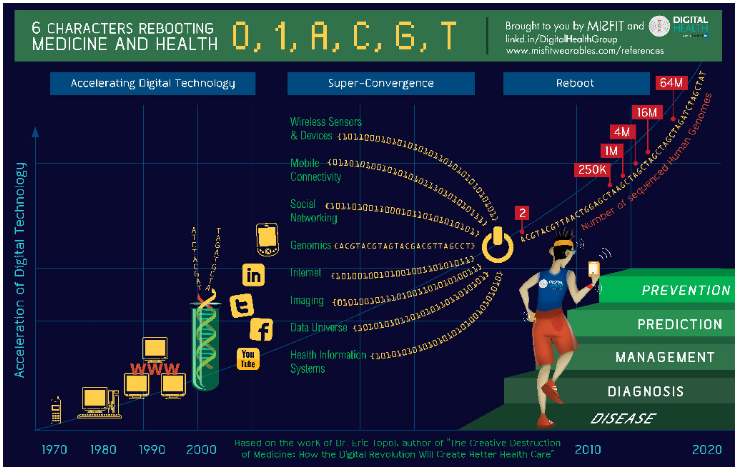
Or take a look at this Digital Health Infographic, created by Paul Sonnier who runs LinkedIn’s huge Digital Health Group:

Obviously, if you’ve spent any time providing clinical care to people who are poor, less educated, or elderly, it can be hard to imagine them donning a sweatband, digitizing themselves, and hustling up the self-empowerment stairs to a wonderful healthy future. (Where the heck are the people who have multi-morbidity or advanced chronic illness in this infographic, anyway?)

If better health will come through smartphones, tablets, and apps, then what happens to the health of those who can’t afford to purchase them, or don’t find them usable?

If better health comes to those who effectively use the internet and their own personal data to chart a better course for their own health, what happens to those who can’t access this information, or can’t sort through it effectively?

The median household income in 2011, according to the Census Bureau, was $50,054. IRS data from 2010 shows that to be in the top 50% of income in the U.S., you only need income of at least $34,338. To be in the top 25% corresponds to income of $69,126 or more. To be in the top 10% = $116,623 or more; to be in the top 5% = $161,579 or more. (And in case you are wondering how much income was required to be in the fabled 1% in 2010, it was at least $369,691.)

Also well known in academia: studies consistently show that both lower socioeconomic status and increased age correspond to greater disease burdens and worse health outcomes.

So in summary, we have technological innovations on the horizon, which is predicted to improve the health and wellbeing of those who can afford them and know how to use them — a group already advantaged by affluence and generally good health.

Will these tech innovations worsen disparities?

Maybe. It would really depend on the circumstances. Specifically, disparities would be increased if:

  • The tech innovations actually meaningfully improve health outcomes.
  • The innovations don’t become available to people of more modest means, lower health literacy levels, or different cultural backgrounds.

However, if tech innovations improve outcomes AND become available to a broader swath of the population, then disparities could potentially decrease a bit.

This doesn’t seem far-fetched to me. There certainly is a digital divide in the country, both along age lines and along socioeconomic lines, but the price of technology is dropping and access is increasing. Health insurers may also be willing to subsidize use of new technologies, if health benefits are clear.

Should improving quality be a higher priority than reducing socioeconomic disparities?

My own answer to this question is definitely yes, especially when it comes to the elderly.

This is because even Medicare beneficiaries who are wealthy, white, and educated often suffer from crummy healthcare.

What do I mean by crummy? Here are some examples of problems I routinely discover in older people of higher socioeconomic status (you’ve probably come across them when it comes to healthcare for your parents or grandparents):

  • Prescription of medications that cause confusion and worsened balance
  • Dementia that goes undiagnosed for far too long; once diagnosed, inadequate education and support for family caregivers
  • Lack of care coordination among multiple specialists and care sites
  • Inadequate understanding of overall health status, health trajectory, and prognosis
  • Lack of non-pharmacological treatment for conditions such as depression, gait instability, pain, incontinence, and dementia behavior management
  • Procedures and diagnostic evaluations of unclear clinical benefit
  • Lack of clarification of values, goals, and care preferences
  • Inadequate symptom monitoring and management, including inadequate pain management
  • Frustration and confusion with the healthcare system

I could go on, but I’ll stop there for now and go back to socioeconomic disparities and improving health quality.

We should definitely keep working on reducing health disparities due to socioeconomic status. The rich will always end up better off than the poor, but given the overall wealth of the US, people in this country should have pretty good health care at all levels of economic status.

However, the fact that even wealthy white educated Medicare beneficiaries suffer from poor health care is sobering. If the system can’t do right by them, how can it hope to do right by the middle class, and lower middle-class? (The truly disenfranchised, such as those suffering from extreme poverty or severe substance abuse, will likely need special resources tailored to their needs.)

So as part of a multi-pronged strategy to improve the healthcare of older adults, it’s valuable to look to the new tech tools and figure out which can help our more advantaged older patients with multiple chronic diseases. Once we’ve made headway on that challenge, we can work on disseminating effective tech tools to those with less income, or adapting them for people of lower educational levels or different cultural backgrounds.

Even if disparities remain, if every section of society has at least moved upwards in health quality, we’ll be better off.

In a nutshell:

Many digital health innovations are most likely to be used by people who are younger, more affluent, and more educated. One can legitimately worry that these innovations will worsen health disparities in the U.S.

However, for innovations to significantly worsen disparities, they would have to both meaningfully improve health outcomes, and not be made available to people of lower economic status. Although the digital divide is real, access to digital tools is increasing for almost all levels of society. Payers may also eventually subsidize tools that have been shown to improve outcomes.

The Medicare population is one in which many suffer from inadequate health care, even when they are wealthy, white, and/or educated. Improving healthcare for older adults requires a multi-pronged strategy, and part of that strategy should be to identify which new digital health tools can improve care in those older adults who are able to access them.

Once suitable tools are developed and identified, additional efforts will be needed to disseminate and adapt them to a broader group of older adults, including those with lower incomes, lower health literacy, and of different cultural backgrounds.

(Disclosure: I have recently opted-out of Medicare — see last FAQ for why — and now only treat people who are more “advantaged.” I admit that I need to believe that by piloting an alternative model of outpatient geriatric care and trying out new technologies with my patients, I’m still serving the cause of better healthcare for all older Americans.)

Filed Under: Uncategorized Tagged With: healthcare technology

PCP behavior change: crucial for tech adoption and improving healthcare

December 13, 2012

These days it seems that everyone wants primary care providers (PCPs) to change, and to improve.

If you believe in better healthcare through use of new technologies, then you want PCPs to adopt new technologies –both within their offices (EMRs and care coordination platforms) and by engaging with technology in the patient’s environment (smartphone apps, aging-in-place technology, etc).

In other words, you want PCPs to do things like prescribe apps (see here for Susanna Fox’s comments on clinicians and stagnant health app adoption), and integrate “observations of daily living” into their clinical work. Or maybe even practice like Eric Topol (see here for why I’d have trouble doing it).

If you believe in more patient-centered and individualized care, then you want PCPs to spend more time developing meaningful collaborations with patients and families. You may also want PCPs to start relying on more accurate individually-generated medical data to make clinical recommendations.

In other words, you want PCPs to consider a patient’s genomic information or personal biometric data set when recommending treatments, and you want them to engage in shared decision-making.

And if you believe in patient and caregiver engagement, then you want PCPs to support and respond to that engagement.

In other words, you’ll want PCPs to encourage, collaborate with, and coach patients and caregivers on successfully managing their health needs, and you’ll want PCPs to be more available to respond to patients’ concerns.

Sounds good to me. I believe in all three of these ideas. The second and third are core components of the geriatric approach (albeit historically done in a much less tech and data intensive fashion), and I think properly leveraging technology will be essential to managing the considerable needs of an aging population in a time of limited resources.

Furthermore, we expect all the above to lead to the holy grail of healthcare improvement: better care at a lower cost. This is plausible: health services research shows that a better primary care infrastructure generally corresponds to better population health outcomes, and more cost-effective care.

Plus, people seem to like having good primary care. Almost everyone prefers to have their health problems treated in the outpatient setting, and would like medical intervention earlier, in order to avoid hospitalizations.

In other words, PCP behavior change seems to be the great hope for improving US
healthcare
. (It’s certainly my own great hope for improving outpatient
geriatric care, since most of that care will be delivered by the
nation’s non-geriatrician PCPs.)

Which is why I think all of us advocating for healthcare change, healthcare improvement, and healthcare tech adoption should be spending lots of time talking about how to motivate and enable PCPs to make these changes.

And if you believe in the motivation science presented in Daniel Pink’s “Drive” – and so far I do — then we should definitely emphasize harnessing PCP’s intrinsic motivation to be better PCPs. (See here for why I think this is important to the healthcare of seniors and frail elders.)

So, I’m currently considering attention to PCP intrinsic motivation as I come across various stakeholders discussing desired changes to the healthcare system.

For instance, in a recent blog post, Caroline Popper describes how she’s helping HHS figure out how to “move reimbursements from ‘fee for services’ to ‘fees for
performance.'” She asks “how do you measure performance? How do
you pay for it?”

Well, those are literally billion dollar questions. If she thinks PCP behavior change is part of the answer, then I hope she and her team will consider the way monetary incentives tamper with intrinsic motivation in professionals. (At the very least we might want to have ACOs be very careful about the way they try to apply incentives to PCP behaviors.)

In another recent post, a mHIMSS editor comments on the need for physician champions to help take mHealth to the next level.

I am all for it, but historically exhorting PCPs to do more or do better hasn’t been enough (although it probably helps to hear it from another PCP). If the mHealth community wants PCPs to engage, can they help create PCP working conditions that nurture internal drive, rather than attempt to change PCPs with monetary incentives?

What about the rest of you? What do you think are viable ways to motivate PCPs to engage and adapt to change?

In a nutshell

The overall improvement of healthcare, especially for seniors, hinges on developing a better system of primary care. This will require PCPs to make substantial behavior changes, especially if adopting new technologies and new ways of practice are required.

The social science described in Daniel Pink’s “Drive” describes the perils of relying on external rewards and punishments, when trying to motivate people to do their best work. In particular, such strategies can seriously erode intrinsic motivation, which is often key to performing creative work or empathic work.

The healthcare changes we all want will require PCPs to step up and do their best creative and emphathic work. If we want PCPs to engage and be open to using new technologies, how can we help harness their intrinsic motivation?

Ideas sorely needed.

Filed Under: Uncategorized Tagged With: Drive, healthcare technology, primary care, technology adoption

  • « Go to Previous Page
  • Go to page 1
  • Go to page 2
  • Go to page 3
  • Go to page 4
  • Go to Next Page »

Primary Sidebar

Get the ebook!

Follow @GeriTechBlog

Featured Posts

GeriTech’s Take on AARP’s 4th Health Innovation @50+ LivePitch

My Process for Meaningful Use & Chronic Care Management

Aging in Place Safely: Dr. K vs APS vs the latest start-up

Recent Posts

  • Smartwatches as Medical Alert Devices
  • Putting Older Adults at the Center of Technology Conversations
  • Using Technology to Balance Safety & Autonomy in Dementia
  • Notes from the Aging 2.0 Optimize 2017 Conference
  • Interview: Upcoming Aging 2.0 Optimize Conference & Important Problems in Need of Solutions

Archives

Footer

Creative Commons License
This work is licensed under a Creative Commons Attribution-NonCommercial-NoDerivs 3.0 Unported License.
Based on a work at geritech.org

Copyright © 2025 · Leslie Kernisan, MD MPH