• Skip to main content
  • Skip to primary sidebar
  • Skip to footer
  • Home
  • Blog
  • Book
  • About
    • About the Blog
    • About the Author
  • For Family Caregivers
  • Contact
    • Feedback on Apps and Services

GeriTech

In Search of Technology that Improves Geriatric Care

geriatrics

Drive: The Surprising Truth About What Motivates Doctors to Provide Better Care to Elders?

November 8, 2012

I’ve recently started reading Daniel Pink’s Drive, and it makes me repeatedly want to jump up and down shouting “Yes! Exactly!”

It also leaves me repeatedly thinking this:

Everyone pushing for better primary care for elders should read (or reread) this book.

As in:

  • Accountable Care Organizations, the great shining hope for healthcare improvement, who will want better care for elders in order to reduce their financial risk (a rather sordid reason to improve care, but there it is).
  • Quality champions, who are trying to figure out how to rejigger systems so that clinicians do better. (Teach them to work in teams!)
  • Policy wonks, who are very into incentivizing providers these days. (Pay clinicians an extra $10 per member per month! That’ll do the trick!)
  • Healthcare entrepreneurs, many of whom seem to believe that primary care clinicians will be shelling out for their innovations in order to compete more effectively in meeting the demands of empowered and engaged consumers. (Hello? Have you heard of the primary care provider shortage in Massachusetts?)
  • Concerned patients and caregivers, who are certainly right to demand better care, and will need engaged and motivated clinicians with whom to forge fruitful collaborations. (Your doctor is probably not going to feel like being more helpful to you because she gets dinged by her ACO when the quality metrics don’t pan out).

For those who haven’t read Drive or aren’t familiar with the basic premise, this is a book that summarizes a recent evolution in how psychologists understand what motivates individuals.

Basically, people used to think that individuals were motivated by essential biological drives (survival, procreation, etc) and then also by rationally responding to extrinsic factors such as rewards (i.e. money) and avoidance of punishments (i.e. fines).

However, psychologists eventually noticed that people often engaged in behaviors for which there was no obvious benefit, other than the enjoyment of engaging in the activity. And in some cases, this activity led to very significant, important products, such as Linux (open-source software) and Wikipedia.

This third drive has been called intrinsic motivation. My guess is that if you are reading this post, you’ve probably already heard about this drive, and maybe even come across some of the literature that suggests that in physicians (a group in which many start with high intrinsic motivation to do their work), use of external motivators may damage intrinsic drive (see here & here).

So my question to all is, if we know about this third drive, then why are most of the suggestions for improving primary care (which should be the foundation of good care for frail elders) rooted in manipulating extrinsic motivators?

Here’s a quote from Pink:

[Organizations] continue to pursue practices such as short-term incentive plans and pay-for-performance schemes in the face of mounting evidence that such measures usually don’t work and often do harm.

Pink goes on to define work as algorithmic (follow a set of instructions) versus heuristic (experiment with possibilities and devise a novel solution). 

Which do you think requires more intrinsic motivation? That’s right, heuristic work.

And does providing comprehensive, compassionate, collaborative care with a medically complex patient and his or her family sound like an algorithmic task to you, or a heuristic one?

This to me, is a no-brainer. Obviously there is much medical care that can and should be done by algorithms.

But not all medical care can be done algorithmically, especially when patients are elderly, complex, embedded in a care circle, and require personalized care and shared decision-making. 

To have quality medical care for elders, primary care providers should be doing complex collaborative problem solving with the patient and family.

That’s heuristic work. That requires intrinsic motivation.

So every time you come across some system, tool, or technique for improving primary care, I suggest you ask yourself:

“How can we use this is a way that improves the clinician’s intrinsic motivation, or at least doesn’t snuff it down too much?”

We should also be talking about how to bolster and support clinicians’ intrinsic motivation to work effectively with patients. Remember, over 50% burnout in front-line clinicians in a recent survey. Unless you truly believe it’s possible to have quality primary care for elders without engaged clinicians, something must be done.

Speaking of what should be done, Cassel and Jain published a Viewpoint in JAMA this past summer which addresses some of the above:

Those advancing physician-level interventions are looking to change how physicians do their jobs. A more global approach—in keeping with more attention to intrinsic motivation—would be to change how physicians perceive their job. Physicians who are satisfied with their work lives provide better care….To reach sustainable quality goals, however, close attention must be given to whether and how these initiatives motivate physicians and not turn physicians into pawns working only toward specific measurable outcomes, losing the complex problem-solving and diagnostic capabilities essential to their role in quality of patient care, and diminish their sense of professional responsibility by making it a market commodity. Rewards should reinforce, not undermine, intrinsic motivation to pursue needed improvement in health system quality.

Ok. I’m going to be thinking about intrinsic motivation as I think about implementing tech and systems to improve geriatric care.

Btw, yours truly is writing this blog on her own time, for no money. Intrinsically motivated 🙂
Filed Under: Uncategorized Tagged With: Drive, geriatrics, primary care

Practical and Prosaic Data Needed by This Doctor

October 16, 2012

Since deciding to delve into the world of healthcare technology and innovation, I’ve repeatedly come across the term “Big Data,” which many claim will be transforming healthcare. As best I can tell, in healthcare terms, Big Data seems to refer to two overlapping ideas. One is that healthcare systems are currently collecting reams of health data, and by analyzing this data, we can identify patterns and signals that we can take action on. The other is that individuals can turn into personal repositories of big data, by frequently measuring various biometric and other parameters (i.e. personal tracking, which leads to the “quantified self”), and then this data can be analyzed and acted upon by the person and healthcare providers.

All well and good, but as with many exciting healthcare tech ideas, I find myself wondering:

“How is this going to help me get the data that I’ve been struggling to get?”

After all, my work requires me to obtain and process a lot of data, namely data regarding a person’s behavior, symptoms, and abilities, and how all of these have changed over time.


Will the Big Data movement help doctors like me?

Here’s a little story to illustrate my data needs in practical terms. Not too long ago, I went on a housecall to see a very elderly man with mild dementia, who lives in a small residential board and care (B&C) facility. The staff there had called the patient’s durable power of attorney (DPOA), saying that the patient, who we’ll call Mr. A., had recently become agitated at night. A urine test had been negative for infection. The B&C staff was wondering if a sedative or other prescription might be indicated. The DPOA had visited the patient and did think he looked less energetic than usual.

“Doctor, what do you think is going on, and what should we do?”

(Actually, people usually just ask the second part of the question, but good medical practice dictates that a clinician should first form a theory of what might be going on, before deciding what to do.)

As many dementia caregivers can tell you, this is a common scenario, and doctors are commonly asked to weigh in and make things better.

The catch is that, to sort out this common situation, one needs data on what has happened. In particular, I needed to know:

  • When exactly did this problem start? Did it start suddenly, or did it come on progressively?
  • Was there an inciting event that can be identified?
  • Is Mr. A distressed at night every night, or just now and then? If now and then, can we identify other factors that fit with the pattern (bowel movements, use of certain medication, etc)?
  • How is his current strength and energy level different from his baseline?

I went to visit the gentleman in question, whom I had never met before. He was very charming and pleasant, but also hard of hearing, and with poor short-term memory. His physical examination did not reveal any obvious cause for the recent concerns. Unsurprisingly, Mr. A. was not able to provide me with the historical data that I needed to make sense of the situation.

So I interviewed the patient’s primary caregiver at the B&C. But here too, the data was hard to obtain. The staffer is Filipino, and although his English seemed ok, he seemed to have difficulty understanding my questions on how Mr. A. seems different now compared to a few weeks ago. He was also inconsistent in his reports of how often specifying how often Mr. A has been having nighttime confusion.

Finally, the caregiver went to find his log book. This facility does not log every resident’s behavior on a daily basis, just “as needed.” We found two entries noting nighttime confusion, the last being a week prior. I left, still uncertain as to just how Mr. A. had changed compared to a month ago. I had just spent over 30 minutes trying to ferret out the data I need for my medical decision-making, and still was not sure I had accurate information to work with.

Given the shortage of geriatricians such as myself, it would obviously be very helpful if technology innovations resulted in my quickly being able access accurate data on a patient’s behaviors and symptoms.

So, will the Big Data movement help a doctor like me? I would say this depends on two key factors:

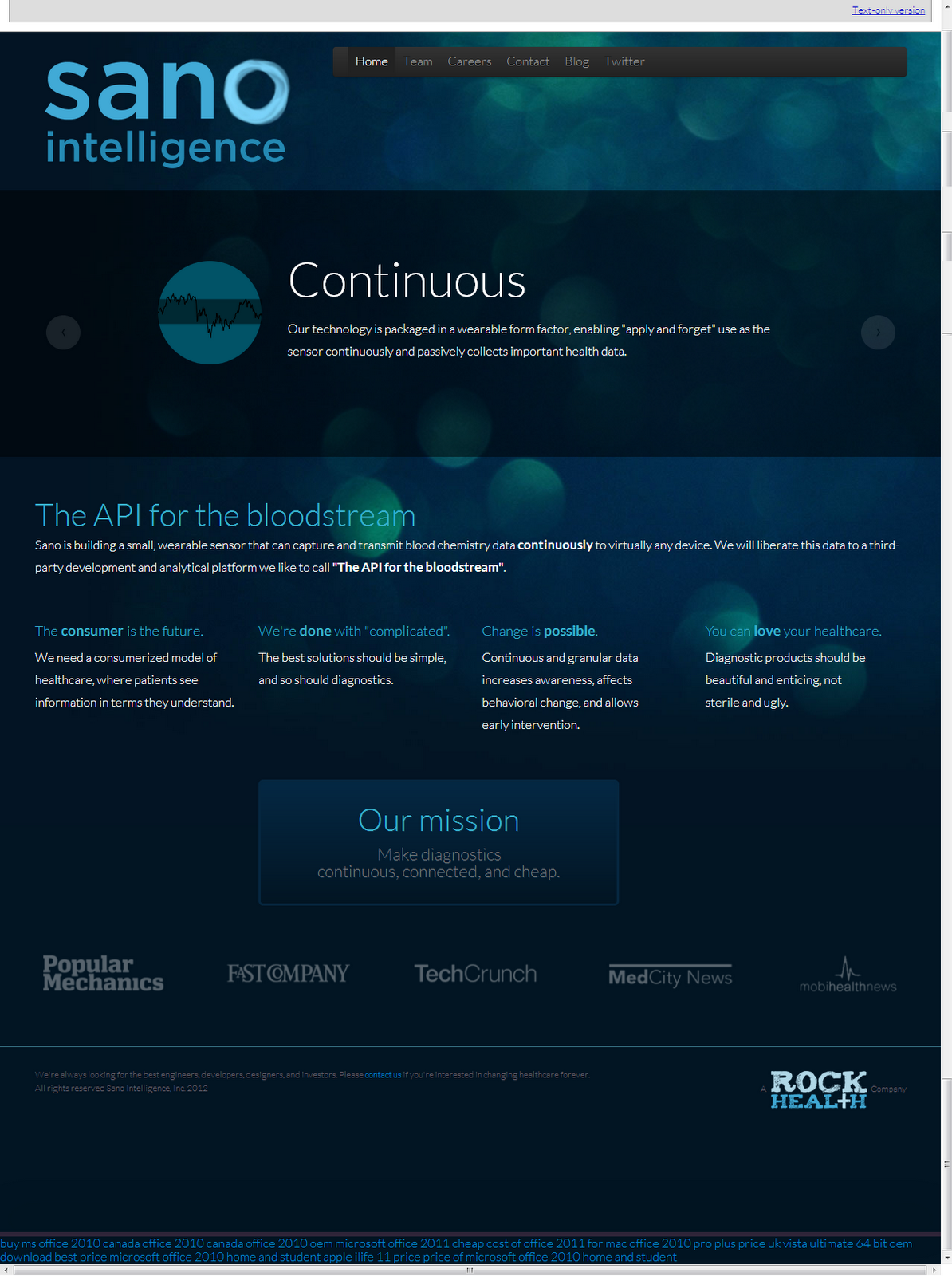
  • Will emerging technologies facilitate the collection of data relevant to geriatricians? Let’s face it, I don’t currently feel a burning need for a “small, wearable sensor that can capture and transmit blood chemistry data continuously.” What I need is something that reliably logs behaviors and symptoms, as well as medication use. [Update 10/17/12: Since yesterday Sano Intelligence, whose site my link points to, has removed the basic info on their blood chemistry sensor. But I am including a screenshot of the cached site below.]
  • Will Big Data shower doctors with information before we are equipped to triage and act on it? It sounds terrific to send more data to doctors, but we’re currently already suffering from information overload. (I wrote about the trouble with apps sending data to doctors last week.) We first need to develop systems that allow us to act effectively on the information we already have.

The truth is, although I think Big Data offers a lot of potential for population health management, I’m a little worried about how it might play out regarding the care of individual geriatric patients. Each elderly person could certainly generate a significant stream of physiologic, behavioral, and symptomatic data. But often collecting more data from frail elderly patients results in more healthcare, much of which ends up being of uncertain benefit. (Example: more scans usually turns into more things to work up and investigate.)

However, here’s an approach that sounds more manageable to me: a system that would allow doctors such as myself to specify the data to be collected, and that would make this data collection manageable and accurate for patient and caregiver.

In other words, instead of bombarding me with data and telling me to help the patient, what if the patient, the system, and I all first agreed on what information would be useful to gather, and then I received it?

Could I get a nightly confusion monitor for Mr. A please, along with an accurate log of his pain and constipation complaints, a record of medications taken including as-needed medications and over-the-counter drugs, and a daily measure of his physical energy, so I can study his trends and patterns? Please?

10/17/12: Here’s a screenshot of Sano Intelligence’s homepage as it was on 10/10/12, with a little description of the kind of data they could be providing:

Filed Under: Uncategorized Tagged With: big data, geriatrics, quantified self, tech for clinicians

  • « Go to Previous Page
  • Go to page 1
  • Interim pages omitted …
  • Go to page 4
  • Go to page 5
  • Go to page 6

Primary Sidebar

Get the ebook!

Follow @GeriTechBlog

Featured Posts

GeriTech’s Take on AARP’s 4th Health Innovation @50+ LivePitch

My Process for Meaningful Use & Chronic Care Management

Aging in Place Safely: Dr. K vs APS vs the latest start-up

Recent Posts

  • Smartwatches as Medical Alert Devices
  • Putting Older Adults at the Center of Technology Conversations
  • Using Technology to Balance Safety & Autonomy in Dementia
  • Notes from the Aging 2.0 Optimize 2017 Conference
  • Interview: Upcoming Aging 2.0 Optimize Conference & Important Problems in Need of Solutions

Archives

Footer

Creative Commons License
This work is licensed under a Creative Commons Attribution-NonCommercial-NoDerivs 3.0 Unported License.
Based on a work at geritech.org

Copyright © 2025 · Leslie Kernisan, MD MPH