• Skip to main content
  • Skip to primary sidebar
  • Skip to footer
  • Home
  • Blog
  • Book
  • About
    • About the Blog
    • About the Author
  • For Family Caregivers
  • Contact
    • Feedback on Apps and Services

GeriTech

In Search of Technology that Improves Geriatric Care

Uncategorized

Tech wanted! Medication reconciliation in outpatient setting

October 25, 2012

Here is an issue that I would love
to get some technological assistance with: medication reconciliation.
Has anyone discovered a good tool
for medication reconciliation, that works for the outpatient setting?
As an outpatient geriatrician, I
spend a lot of time reviewing medications, and it’s not uncommon for my
patients to be taking 10-15 medications. This is clinically VERY important; medications are a top cause of delirium, falls, and other adverse effects in non-hospitalized elders.
The problem: even if I have an
accurate list of what has been prescribed by myself and the other involved
doctors (a big if — more on that soon), matching this up with what the patient is
taking tends to take a while. Here’s what I used to do at my previous clinic
job, which had a medication list in the e-prescribing system, and also in the
paper chart:
  1. Get the patient to bring in all bottles. (Usually involves multiple reminders and some coaxing; it’s hard to get patients to not juts bring in their outdated list from 6 months ago.)
  2. As I look at a bottle, check it off against the
    existing list. (Oh wait, if I want an existing list I can scribble on, I
    need to copy the list we have, or print from e-prescribing; doing either task will set me further behind.)
  3. Forget about checking it off. I decide to just write
    down all the meds, and then compare it against the list I have, using my
    eyeballs and brain to stop the discrepancies.
  4. Hm. These two lists are long, and the meds are in
    different orders. Maybe I should start by counting the two lists and
    seeing if I have the same number of meds on each one.
  5. Aha! The original list says metoprolol 50mg bid, but
    the patient has brought in a bottle that says metoprolol 100mg bid.
    Discrepancy identified!
  6. As I start to inquire about this discrepancy, the
    patient brings up three other problems of greater concern to her, and I
    never finish spotting the other discrepancies during the visit.
Yes I admit it, I often found it
very difficult to get through comprehensive medication reconciliation at an
outpatient visit. 
But this is part because this is one
of the many tasks that providers are often left to do with eyeballs and brain,
even though of course computerized technology can do this faster and better.

Here’s a hypothetical technological set-up to do medication reconciliation faster:

  1. Patient’s med list is kept in some kind of program,
    perhaps web-based. Ideally this should be accessible for viewing by the
    patient as well as the provider.
  2. Meds at the visit get input into the program. Ideal
    would be for the entry to bypass human eyes and finger, like barcode
    scanning. Heck, maybe you could even snap pictures of QR codes on the bottle, as these are now all
    the rage. (Why don’t prescription med bottles come with barcodes that can be read in clinic??)
  3. The computer doesn’t care that the meds were entered in
    a different order. It can rearrange them and identify the discrepancies in
    a snap.
  4. One second later, provider has a list of the
    discrepancies, and can start investigating.
So, does this exist?? My preliminary
Google search reveals that:
  • Microsoft HealthVault
    can download medication info from some big pharmacy chains like CVS and
    Walgreen’s. I suppose you’d have to enter your own meds post
    hospitalization. And it’s unclear from their promotional materials how
    HealthVault helps patients, families, and providers spot discrepancies.
  • A company called PatientKeeper
    claims to have recently rolled out the “First Physician-Friendly Med
    Rec Software Application”. Unclear how you enter meds at a visit, or how usable
    it is in outpatient setting.

In general, when I look into technology for medication reconciliation, I overwhelmingly find tools like this one, which are:

  • designed for med rec in hospital, not outpatient setting
  • focus on reconciling what has been prescribed, rather than what the patient actually has on hand. 

Obviously it’s very important to achieve medication reconciliation during hospital admission and discharge. 

But as everyone agrees that it’s important to provide good outpatient care, in order to avert hospitalizations and maintain wellness, we really need better med rec tools for the practicing primary care clinician.

How are the rest of you managing outpatient medication reconciliation for elders? Have you come across any tool or technology that can make this med rec process more doable in the usual outpatient clinic setting?
Filed Under: Uncategorized

Eric Topol’s tech tools: what it would take for this doc to use

October 23, 2012

Last week Wired Magazine hosted a Wired Health Conference (subtitled “Living by the Numbers”) in NYC. As there was lots of buzz about Dr. Eric Topol’s talk, “Information into Action,” I watched it online after the fact. It’s a very interesting interview with Wired’s Thomas Goetz, in which Topol describes a handful of new technological tools that he feels doctors should be using. In fact, he states that “we’re trying to get a lot of things out into the real world of everyday care.”

Now, I’m a practicing doc interested in finding and adopting technology that will improve geriatric care. So whenever I hear about a new tech tool recommended to doctors, two questions come to my mind:

  1. Does this sound like it will improve the clinical care of my patients (frail and vulnerable elders), at a reasonable cost?
  2. What would it take for a doc such as myself to integrate using this tool into my workflow?

In this post I’ll briefly describe the tech tools Topol mentioned in his talk, and share my initial thoughts on them.

For those who haven’t heard of Eric Topol: he’s a well-respected cardiologist and expert in using genomics and digital technologies to personalize prevention and management. Among other things, he’s famous for using a nifty iPhone add-on called AliveCor (turns your iPhone into a mobile ECG) on a plane to diagnose a case of acute coronary syndrome. He also no longer uses a stethoscope, preferring to use a Vscan (a pocket-sized ultrasound) to visualize valves as part of the physical exam. His book, “The Creative Destruction of Medicine: How the Digital Revolution Will Create Better Health Care,”
is often referred to as a “must-read” for those interested in the
bright healthcare future that technology will bring to us. (Confession:
haven’t read it yet, but probably will some time soon.)

The tech ideas described by Topol and Goetz during this talk (my thoughts on each idea are in purple):

  • Pharmacogenomics-based prescribing. How exactly might you personalize medical care based on someone’s genome? Topol proposes pharmacogenomics as a good place to start. The FDA has a list of drugs with known genomic interactions (I found it here; 117 drugs on it). For instance, according to the talk, Plavix (clopidogrel) doesn’t work in 1 of 3 people due to a genomic factor that can be identified through www.23andme.com.
    • Wow, between stents and strokes, many older adults have an indication for Plavix. I’d heard that some are resistant, but if a commonly used drug really doesn’t work for a third of people, then considering pharmacogenetics would improve clinical care for my patients. Cost-effectiveness as of yet unclear to me.
    • But how am I supposed to know which drugs require special dosing? Hard to keep track unless a specific genomic testing recommendation is going to start popping up in the e-prescribing systems. (Vague warnings that there is a genomic interaction without further specifics on what to do are not very helpful to providers.)
    • Added twist: Uptodate.com, the clinical decision-support tool I use on the fly, has a topic page on clopidogrel resistance, but the summary recs “suggest against routine testing of patients for “clopidogrel resistance“, whether by in vitro testing of platelet function or by genetic testing for CYP2C19 poor metabolizers (Grade 2C).”
      • Uh-oh. Discrepancy between what I hear from Wired Health and Uptodate. I could dig through the literature to arbitrate, but in general, I am just going to go with the clinical decision support tool I trust.

  • Point-of-care genotyping. Topol explains that a barrier to using genomic information is the usual week-long delay in getting test results. He proposes that one is more likely to act on genomic information if one can get it at the point of care (POC), rather than having to wait a week. He’s been working with a company called DNA Electronics, which is developing a rapid POC genotyping test. They are envisioning pharmacists doing the test (customer gets to shop in the store for 15 min while awaiting results), and then being able to help match up “the right person with the right drug and right dose.”
    • Hm. Unclear whether the test would have to be ordered by a doc, would get ordered by insurance, or would be up to the patient to request. There are pluses and minuses to all three options; suspect the issue will be heavily wrangled in next few years.
    • The value of increased access to genomic testing would really depend on what was being genomically tested for, and whether acting on that information has been shown to improve outcomes. (As you can see from the example above, there is clearly debate on when genomic testing adds value.)
    • Workflow question: when test results are available after 10-20 min, does the pharmacist call a doc, or dispense based on a protocol? How are the docs notified?

  • Nanosensors in the bloodstream. This one’s a little further off in the future, but this source of Big Data’s coming within a few years to a bloodstream near you. Scripps Digital Medicine has a grant from Qualcomm Foundation to work on these nanosensors (90 microns), that would be carried by the bloodstream and embed in a capillary somewhere. The sensors could track a bloodborne signature of pathology, like signs of an impending heart attack or autoimmune attack, and send the information to a nearby smartphone.
    • This is intellectually intriguing, but in practical clinical terms, I’ve already written about my concerns with apps sending data to doctors (we’re not currently equipped to deal).
    • There is also the question of what kind of continuous data monitoring is appropriate for the geriatric population; what I think would help me provide better care is the ability to query a data stream related to symptoms and behavior. 
  • AliveCor. This is the iPhone-into-ECG technology mentioned above. Topol uses it all the time, despite it not yet being FDA-approved. (Doctors, you can get one here if you pretend to be a veterinarian.)
    • I do have a clinical need for something like this. I see a lot of homebound older folks who otherwise do not have easy access to an ECG. And I often hear irregular heart sounds, and wonder if they are having ectopy versus afib.
    • But assuming the FDA eventually approves something like this, who will help me interpret the rhythm strip? There was a time during my UCSF residency when I got really good at reading ECGs. (I once pissed off a bigwig attending by questioning the ECG machine’s automated interpretation, which the attending had accepted. The cardiology fellow sided with me, but I was still left in deep diplomatic doo-doo.)  Eight years later, I’m hardly ever called upon to interpret a rhythm strip on the fly, and I don’t feel comfortable doing much more than identifying afib. I would certainly feel better using this if it came with a feature allowing me to send to someone who could confirm the interpretation, or some other form of clinical decision support. I don’t need more work or uncertainty to deal with.

  • Wearable continuous glucose monitor. This one uses a 27 gauge needle and you can continuously follow your blood glucose on your smartphone. Unclear to me how it’s different from what some diabetics currently wear (other than talking to the smartphone). Topol sounded like he’s envisioning regular people wearing these and continuously getting feedback on how their diets are affecting blood glucose.
    • This probably has some value for the exploding population of diabetics and prediabetics. For my own older patients however, I can only envision recommending this to the truly brittle diabetics, or others in which continuous monitoring is shown to improve outcomes.
    • This is yet another source of Big Data, so we again need to consider what patients will expect of physicians, and how we can equip physicians to deal with this data stream. 
  •  Vscan.  “Why would I listen to lub-dub?” asks Topol, when a handy pocket ultrasound can just show you just what the heart valves are up to. Topol believes that this should be “part of the physical exam.” He points out that this could save a lot of money by replacing some of the thousands of $800 echocardiograms that are done every year. Note to medical educators: Topol says that Mt. Sinai’s med school is now giving Vscans to the entering students, rather than stethoscopes (um… and the lung sounds?).
    • This is basically offering patients a POC abbreviated echo. For frail elders who are already struggling with too many appointments and getting to clinics, this could be beneficial, and probably cost-effective (unless all the POC echos generate follow-up complete echos).
    • But how often will I find something using Vscan that changes management without requiring a full echo?
    •  And how do I get to the point of using a Vscan? How much training would I need to feel comfortable making a preliminary interpretation of what I see? Who is available for a backup read? How do I document the findings in my EHR?
    • Who’s going to pay for me to have this Vscan anyway? I’m in private practice, as are many primary care docs. Am I supposed to pay to get this because this will bring more patients into my office? (Um, a geriatrician always has more than enough demand for her services, and there’s a shortage of primary care docs in general.)

My conclusions on Topol’s talk:

He’s got a lot of interesting ideas on how we doctors might be using technology soon. He is certainly promoting these ideas to consumers before we know if these technologies will improve health outcomes. I can’t blame him for this; the usual methods of conducting peer-reviewed research can’t possibly keep up with the pace of technological innovation. A little consumer pressure might be what we docs need to up our game and move into the 21st century.

Still, before society invests a lot of money into healthcare driven by these technologies, the outcomes issue is important. Technological advances are one of the primary drivers of increasing health care costs, and historically have not always generated cost savings, although that’s not to say the right technologies couldn’t do a better job of this in the future. Needless to say, it’s not the job of tech companies or most tech evangelists, including Wired, to ensure that adopting new technologies bends the cost curve. They provide the tools and spread the word. Policymakers and payors have to figure out what to do with them.

Plus there are special considerations related to geriatrics and the care of medically complex adults. Geriatrics in particular is riddled with examples of excess technology and diagnostic efforts leading to harmful excess care, and unimproved outcomes. So I find it hard to not feel cautious when thinking about implementing these technologies in the Medicare population, whose fate is about to make or break the nation’s financial outlook.

Last but not least, there are the nitty-gritty issues related “getting this into the real world of everyday care,” which means getting everyday docs to use these new technologies:

  • How do we keep up with an exploding array of new diagnostic and therapeutic techniques? It’s not just about rebooting medical school; how will we reboot the million doctors already at work? We  need viable strategies that allow us to keep up with the changes (assuming the experts agree on what new technologies we should be using). The week of paid CME time that many get is not enough.
  • How do we get time and infrastructure to help patients with the data that they will apparently be bringing to us?
  • How does society plan to make it viable from a financial and workflow perspective, for us to adopt this neat new diagnostic equipment in our day-to-day practice?

So, it’s all good food for thought, but at the end of the post, is this geriatrician willing to adopt any of the technologies listed above?

Actually, I thought about ordering the Alivecor last night. I have a homebound and confused elderly patient who could use an ECG, but I haven’t yet found a mobile ECG service to give me some info on what his heart is up to. He is anxious and desperately wants to avoid going to the ER, so pursuing an ECG under current conditions would impose a significant burden on him and his family.

I’ll keep thinking about it for now. I do have a cardiologist friend who would read the strip, if I’m able to securely email it to her.

Filed Under: Uncategorized

Big Data for Frail Elders: A model for tracking behavior and symptoms in the home

October 18, 2012

As I described earlier this week, in my line of doctoring I frequently find myself struggling to obtain the kind of big data that I need: data on a frail elder’s symptoms and behaviors over the past days to weeks.

So I was delighted to meet yesterday with Julie Menack of 21st Century Care Solutions, a Bay Area geriatric care manager (GCM) with a special interest in applying technology to the care management of the elderly. She pointed me towards eCaring.com, an online platform for managing and monitoring home care services. (Disclosure: Julie is a paid consultant for eCaring. I have no current or planned financial ties to either eCaring or to Julie, although given that Julie and I provide complementary services to frail elders in the Bay Area, we will probably have an opportunity to serve the same client/patient eventually.)

The idea of eCaring seems to be this: caregivers, especially the ones hired by care managers, often keep daily logs to record the care provided, as well as how the care repicient is doing. Of course historically records have been kept on paper, often in a “care binder.”

The trouble with paper and binders, however, is that this information is difficult to share and analyze. I personally hate it when people refer me to a binder for information. It’s the 21st century, people. If the information counts, it needs to be in a computer, AND backed up.

Enter eCaring. This company provides a computer-based platform for caregivers to record all this information (this part is called CareTracker). The information can then be shared with family, case managers, or healthcare providers, through review of the CareJournal, or by using the CarePortrait feature, which creates customized reports.

The platform will also eventually include an alert feature. Once the parameters of an alert have been defined, then entering a trigger prompts a notification sent by text or email to designated recipients.

Of most interest to me is that if information is regularly and properly
documented, this creates a database of information that is potentially
very useful to me clinically. The platform does support a form of
querying the data, to focus on a trend related to eating or pain, for
instance.

So will eCaring actually work for my purposes? And will it lead to better health outcomes for elders?

I can’t say for sure, as I haven’t tried it yet. And since it’s fairly new, Julie herself is just starting to pilot it with clients.

However, the concept has a lot of potential. Finding an effective way to document and manage this information could be extremely helpful for care coordination purposes. And access to this type of information could help doctors such as myself evaluate common complaints that come up for geriatric patients.

In the end, the proof will be in the pudding. Entering a lot of data is often harder for on-the-ground users than we expect. For a doctor like me, the data also needs to be easily viewed, sorted, and queried; if it’s a pain to do this, we’ll find doctors yet again avoiding the information rather than engaging with it.

Another issue that will affect adoption is cost. eCaring is currently offering a free three month trial, but unclear to me how much it costs afterwards. And who will pay? Families out-of-pocket? Or perhaps hospitals post admission? Will accountable care organizations be interested?

Last but not least, as I’ve said before, if this becomes a stream of data aimed at providers, we will have to find ways to give providers time and infrastructure for reviewing and responding to the data. (We already have over 50% of docs in front-line specialties such as general internal medicine with signs of burnout; more data to take care of won’t help unless working conditions become more supportive.)

Despite all these caveats, I’m excited to learn about eCaring, and hope to get an opportunity to try it out soon.

By the way, my brief Google search didn’t turn up any similar products, but if you know of one, definitely let me know in the comments or by email.

Filed Under: Uncategorized

Practical and Prosaic Data Needed by This Doctor

October 16, 2012

Since deciding to delve into the world of healthcare technology and innovation, I’ve repeatedly come across the term “Big Data,” which many claim will be transforming healthcare. As best I can tell, in healthcare terms, Big Data seems to refer to two overlapping ideas. One is that healthcare systems are currently collecting reams of health data, and by analyzing this data, we can identify patterns and signals that we can take action on. The other is that individuals can turn into personal repositories of big data, by frequently measuring various biometric and other parameters (i.e. personal tracking, which leads to the “quantified self”), and then this data can be analyzed and acted upon by the person and healthcare providers.

All well and good, but as with many exciting healthcare tech ideas, I find myself wondering:

“How is this going to help me get the data that I’ve been struggling to get?”

After all, my work requires me to obtain and process a lot of data, namely data regarding a person’s behavior, symptoms, and abilities, and how all of these have changed over time.


Will the Big Data movement help doctors like me?

Here’s a little story to illustrate my data needs in practical terms. Not too long ago, I went on a housecall to see a very elderly man with mild dementia, who lives in a small residential board and care (B&C) facility. The staff there had called the patient’s durable power of attorney (DPOA), saying that the patient, who we’ll call Mr. A., had recently become agitated at night. A urine test had been negative for infection. The B&C staff was wondering if a sedative or other prescription might be indicated. The DPOA had visited the patient and did think he looked less energetic than usual.

“Doctor, what do you think is going on, and what should we do?”

(Actually, people usually just ask the second part of the question, but good medical practice dictates that a clinician should first form a theory of what might be going on, before deciding what to do.)

As many dementia caregivers can tell you, this is a common scenario, and doctors are commonly asked to weigh in and make things better.

The catch is that, to sort out this common situation, one needs data on what has happened. In particular, I needed to know:

  • When exactly did this problem start? Did it start suddenly, or did it come on progressively?
  • Was there an inciting event that can be identified?
  • Is Mr. A distressed at night every night, or just now and then? If now and then, can we identify other factors that fit with the pattern (bowel movements, use of certain medication, etc)?
  • How is his current strength and energy level different from his baseline?

I went to visit the gentleman in question, whom I had never met before. He was very charming and pleasant, but also hard of hearing, and with poor short-term memory. His physical examination did not reveal any obvious cause for the recent concerns. Unsurprisingly, Mr. A. was not able to provide me with the historical data that I needed to make sense of the situation.

So I interviewed the patient’s primary caregiver at the B&C. But here too, the data was hard to obtain. The staffer is Filipino, and although his English seemed ok, he seemed to have difficulty understanding my questions on how Mr. A. seems different now compared to a few weeks ago. He was also inconsistent in his reports of how often specifying how often Mr. A has been having nighttime confusion.

Finally, the caregiver went to find his log book. This facility does not log every resident’s behavior on a daily basis, just “as needed.” We found two entries noting nighttime confusion, the last being a week prior. I left, still uncertain as to just how Mr. A. had changed compared to a month ago. I had just spent over 30 minutes trying to ferret out the data I need for my medical decision-making, and still was not sure I had accurate information to work with.

Given the shortage of geriatricians such as myself, it would obviously be very helpful if technology innovations resulted in my quickly being able access accurate data on a patient’s behaviors and symptoms.

So, will the Big Data movement help a doctor like me? I would say this depends on two key factors:

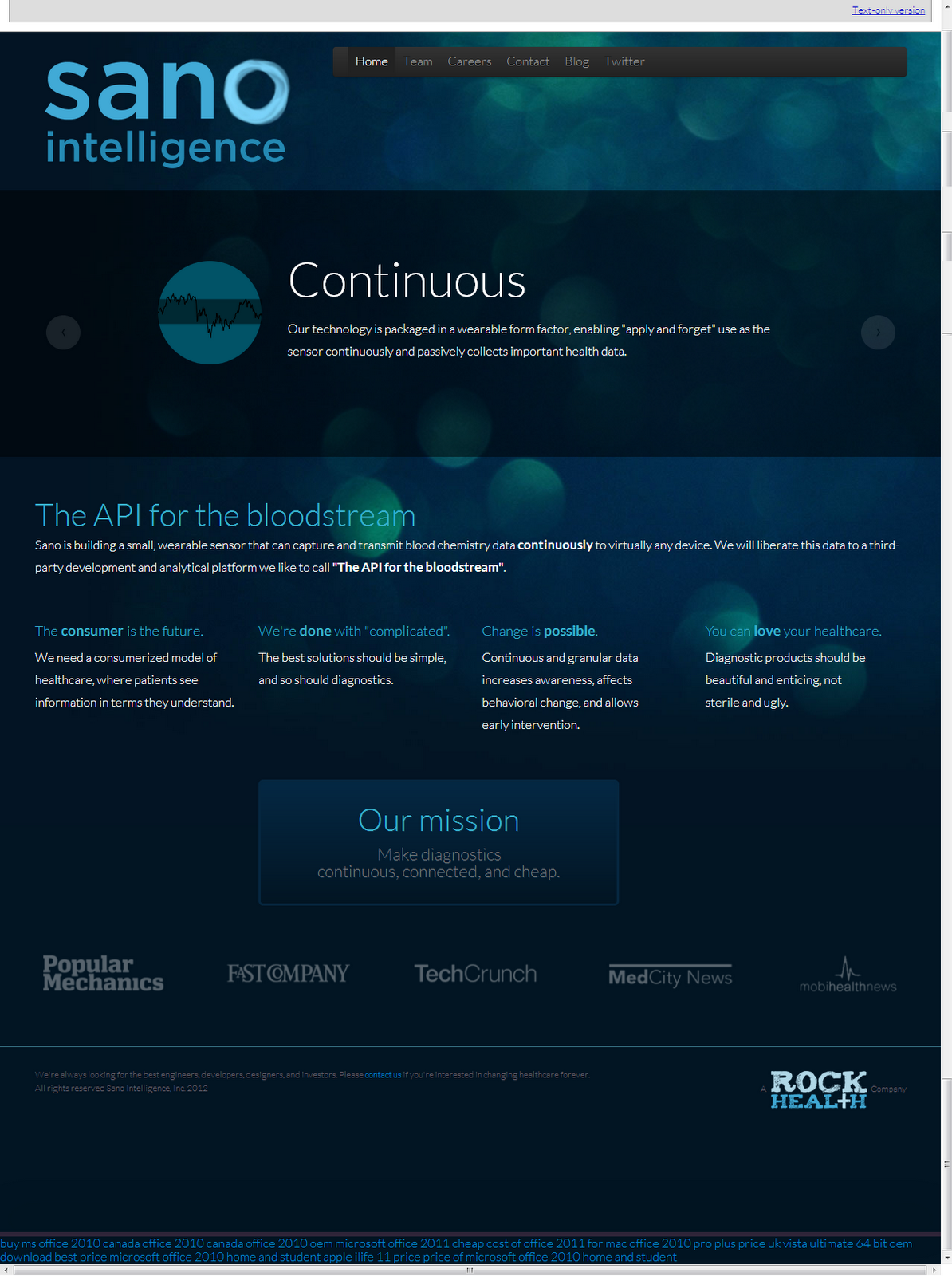
  • Will emerging technologies facilitate the collection of data relevant to geriatricians? Let’s face it, I don’t currently feel a burning need for a “small, wearable sensor that can capture and transmit blood chemistry data continuously.” What I need is something that reliably logs behaviors and symptoms, as well as medication use. [Update 10/17/12: Since yesterday Sano Intelligence, whose site my link points to, has removed the basic info on their blood chemistry sensor. But I am including a screenshot of the cached site below.]
  • Will Big Data shower doctors with information before we are equipped to triage and act on it? It sounds terrific to send more data to doctors, but we’re currently already suffering from information overload. (I wrote about the trouble with apps sending data to doctors last week.) We first need to develop systems that allow us to act effectively on the information we already have.

The truth is, although I think Big Data offers a lot of potential for population health management, I’m a little worried about how it might play out regarding the care of individual geriatric patients. Each elderly person could certainly generate a significant stream of physiologic, behavioral, and symptomatic data. But often collecting more data from frail elderly patients results in more healthcare, much of which ends up being of uncertain benefit. (Example: more scans usually turns into more things to work up and investigate.)

However, here’s an approach that sounds more manageable to me: a system that would allow doctors such as myself to specify the data to be collected, and that would make this data collection manageable and accurate for patient and caregiver.

In other words, instead of bombarding me with data and telling me to help the patient, what if the patient, the system, and I all first agreed on what information would be useful to gather, and then I received it?

Could I get a nightly confusion monitor for Mr. A please, along with an accurate log of his pain and constipation complaints, a record of medications taken including as-needed medications and over-the-counter drugs, and a daily measure of his physical energy, so I can study his trends and patterns? Please?

10/17/12: Here’s a screenshot of Sano Intelligence’s homepage as it was on 10/10/12, with a little description of the kind of data they could be providing:

Filed Under: Uncategorized Tagged With: big data, geriatrics, quantified self, tech for clinicians

Neat new way for families to find in-home caregivers

October 12, 2012

Here’s an exchange that frequently comes up between me and an overwhelmed family caregiver (CG):

Me: “You are doing such a fantastic job helping your mother out. She’s really lucky to have you be so involved. And, it sounds like she needs more help at home than you’re able to comfortably provide on your own. Have you considered hiring an in-home caregiver to come help out?”

CG: “How do I find someone reliable? How much does it cost?”

Me: “Umm….Let’s see if we can connect you with a social worker who can help you. You can also try calling the Family Caregiver Alliance. They should have resources on how to hire in-home help, and they may have some kind of registry of home care providers.”

Three weeks later:

Me: “Did you look into getting some help at home?”

CG: “Umm…I’m planning to, but I’ve been so busy…”

Six weeks later:

Me: “Did you look into getting some help at home?”

CG: “Umm…I have this list of agencies…”

And so it goes, with me continuing to encourage the beleaguered caregiver to get some help, and the caregiver struggling to address yet another complex task as he or she scrambles to keep up with the challenges of caregiving.

The problem, of course, is that as the doctor, I’m pointing at
something to be done, but am not able to lay out concrete simple steps that a family caregiver can execute. Instead of relieving the caregiver’s stress, I’m giving him or her another complex problem to solve.

Family caregivers could certainly use some technology that simplifies the process of investigating and hiring in-home help.

The good news: some healthcare tech entrepreneurs are working on just this problem. As some may recall, last week when I briefly reviewed AARP’s top healthcare innovations for 50+, the startup I was most interested in was Carelinx, an online platform to help people find and manage paid caregivers.

Well, Carelinx was featured at the Aging 2.0 event I attended last night, and after learning more about the concept, I still think this is a service that could meet an important need for families I work with.

(Full disclosure: Carelinx contacted me last week after I mentioned them on GeriTech.org and I recently lunched with CEO Sherwin Sheik, who was interested in my experience as a geriatrician. We have no current or planned financial ties. He did strike me as very nice and has personally experienced the challenge of trying to hire in-home help for a sister with MS and an uncle with ALS.)

Why? Because Carelinx reminds me of Airbnb, a service that I have found genuinely super helpful and an example of how Internet platforms can

1) make a complicated search task much easier, and

2) facilitate an individual-to-individual transaction.

Like Airbnb, Carelinx provides a user-friendly platform that facilitates searching for what one needs. Users can easily look through a roster of individuals proposing caregiving services, and filter based on criteria such as gender, years of experience, credentials, and types of past caregiving experience. If you choose to hire someone, the platform manages the scheduling, payments, taxes, and also insurance and bonding. (Confession: I’m not really sure what the bonding means, but sounds reassuring.)

An additional feature I found appealing is that the platform supports video interviews with a prospective caregiver, which is a great tool for getting a sense of a person before moving towards an in-person meeting.

Last but not least, Carelinx claims that since they charge less as a middleman than traditional in-home care agencies do, families can obtain help for less, and the caregivers themselves get paid more. If this is true, this is a great benefit for families, who often face financial constraints, and for the caregivers themselves.

Does Carelinx actually work well for families? I can’t say, as I don’t know anyone who has hired a caregiver through the service. 

Obviously families looking for an in-home caregiver should consider other options. For some, working with an established agency that provides coordinated geriatric care management services may be a better fit. There may also be other companies online that do a better job allowing families to find a suitable caregiver. (However, my brief Google search today didn’t turn up anything more promising: lots of agencies, lots of referral services, and Care.com, which does have a roster of available caregivers but doesn’t seem to provide the infrastructure for managing an ongoing client-caregiver arrangement.)

And it’s unclear to me how well an Internet company like Carelinx can screen and vet caregivers, although as Jim Sabin notes on the Over 65 Blog, that’s been an issue with traditional agencies as well.

Still, when I consider the options I have historically provided (I do love you Family Caregiver Alliance, but I worry that my families need something that feels easier than this process), I think Carelinx’s approach has terrific potential.

In many arenas, Internet platforms have replaced traditional middlemen (i.e.buying airline tickets, renting vacation homes, hiring freelancers). This has generally led to more transparency, better prices for consumers, improved customer service due to reviews and ratings, and an overall simplified experience.

Will this approach yield similar benefits in the realm of hiring an in-home caregiver? My guess is probably, but we’ll have to see.

In the meantime, I’m glad to hear of another option that I can propose to families.

PS: Health services providers: if you know someone who’s used Carelinx or a similar platform, I’d love to hear from you.

Filed Under: Uncategorized Tagged With: caregiving

  • « Go to Previous Page
  • Go to page 1
  • Interim pages omitted …
  • Go to page 20
  • Go to page 21
  • Go to page 22
  • Go to page 23
  • Go to page 24
  • Go to Next Page »

Primary Sidebar

Get the ebook!

Follow @GeriTechBlog

Featured Posts

GeriTech’s Take on AARP’s 4th Health Innovation @50+ LivePitch

My Process for Meaningful Use & Chronic Care Management

Aging in Place Safely: Dr. K vs APS vs the latest start-up

Recent Posts

  • Smartwatches as Medical Alert Devices
  • Putting Older Adults at the Center of Technology Conversations
  • Using Technology to Balance Safety & Autonomy in Dementia
  • Notes from the Aging 2.0 Optimize 2017 Conference
  • Interview: Upcoming Aging 2.0 Optimize Conference & Important Problems in Need of Solutions

Archives

Footer

Creative Commons License
This work is licensed under a Creative Commons Attribution-NonCommercial-NoDerivs 3.0 Unported License.
Based on a work at geritech.org

Copyright © 2025 ยท Leslie Kernisan, MD MPH