• Skip to main content
  • Skip to primary sidebar
  • Skip to footer
  • Home
  • Blog
  • Book
  • About
    • About the Blog
    • About the Author
  • For Family Caregivers
  • Contact
    • Feedback on Apps and Services

GeriTech

In Search of Technology that Improves Geriatric Care

Uncategorized

What Accenture Says Seniors Want re Health & Technology

March 6, 2015

From http://newsroom.accenture.com/news/tech-savvy-seniors-want-online-options-to-access-care-from-home-accenture-survey-shows.htm


This week I almost fell out of my chair when I came across Health Populi’s recap of an Accenture survey on seniors and healthcare technology.

The particular finding that surprised me was this one:

  • 3 in 5 older people are likely to join an online community to check a clinician’s advice before taking it on

Really??

I was surprised since as far as I can tell, it doesn’t cross most people’s mind to look for an online community to check a clinician’s advice, although I do think it’s become quite common for people to look things up on WebMD and at MayoClinic.

Of course, I’d be thrilled if more people would adopt an e-patient approach and do some double-checking before accepting a doctor’s advice. This is a good way to make sure you’ve explored other options, and can help reduce medical errors. But sorting through information online takes skills, as does bringing up what you found to the doctor. (Doctors should be amenable, but many are not.)

Accenture’s press release for the survey is here. I found this finding striking too:

  • A third of seniors would prefer to work with a patient navigator to manage their healthcare. Last year, $384 million was invested in solutions, like patient navigators, for care navigation.

Interesting, no? Does this represent a failure of primary care for seniors? Shouldn’t the role of a good PCP is to be a navigator for choices and health strategy? (People also often want help managing healthcare logistics, which is something that could be done by a medical home, a care manager, etc.)

Other findings Accenture highlights are:

  • “More than two-in-three seniors prefer to use self-care technology to independently manage their health”
  • “More than three-in-five seniors are willing to wear a health-monitoring device to track vital signs, such as heart rate and blood pressure”
  • “A quarter of seniors regularly use electronic health records for managing their health, such as accessing lab results (57 percent)”

Accenture seems to conclude that the “top five areas for growth” are self-care, wearables, online communities, navigating healthcare, and health record management.

What to make of Accenture’s findings?

Over ten thousand adults aged 65+ were surveyed for this report (in May-June 2014) but only 354 were U.S. Medicare beneficiaries. That’s because this is a survey of seniors in ten countries, assessing “their perceptions of using technology to manage their health.”

The press release didn’t have a link to Accenture’s full report, much less the survey questions they actually asked.

Personally, I found these results intriguing but they also seem a bit tech-optimistic, as does much in the digital health arena.

One could raise endless methodological questions about this press release: How representative were the respondents of other seniors in their country? Were there differences by country? What are the seniors thinking of when they hear “self-care technology” and what does it mean to “independently manage their health”?

And how much does the Accenture team know about the best way to help seniors manage health, and health problems?

Consider this, from the press release:

“The survey showed seniors who place a higher priority on technology are more likely to proactively manage their health. For example, most seniors (75 percent) who value technology are active in tracking their weight digitally, compared to 43 percent of those who do not. Similarly, half of tech-savvy seniors are actively monitoring their cholesterol, compared to 31 percent of those who do not value technology.”

Wow. This is a good example of data that doesn’t help you solve useful problems. (If you’re a clinician that is; I guess this might help businesses figure out who they should market their products to.)

Clinically, I am perplexed by what it means for seniors to “actively monitor their cholesterol.” Unlike monitoring weight and exercise, monitoring cholesterol is something they can’t do without partnering with doctors. Sometimes I think business people act as if managing health is like managing your banking or travel plans: just give me a good website and I’ll conveniently take care of it myself! But once people have active health problems, it’s much more complicated.

So what to make of Accenture’s report? My main take-away is that interest in senior health technology is on the rise. Whether or not Accenture is right, it’s interesting to see how they are framing the digital health needs for the people we care for.

[Many thanks to Carla Berg for bringing this survey to my attention. Do read the Health Populi piece; it includes data from the Utilization Patterns and Out-of-Pocket Expenses for Different Health Care Services Among American Retirees, published in February 2015.]
Filed Under: Uncategorized

A Tale of Two Sore Throats: On Retails Clinics & Urgent Care

February 23, 2015

[This post was first published on The Health Care Blog on 1/28/15, and was re-posted to KevinMD on 2/21/15. The comments are worth reading at both sites.]

Six
years ago, just after arriving in Baltimore for a winter conference, I fell
sick with fever and a bad sore throat.
After
a night of feeling awful, I went looking for help. I found it at a Minute
Clinic in a CVS near the hotel. I was seen right away by a friendly NP who did
a rapid strep test, and prescribed me medication. I picked up my medication at
the pharmacy there. The visit cost something like $85, and took maybe 30
minutes. They gave me forms to submit to my California insurance. And I was
well enough to present my research as planned by day 3 of the conference.
Fast
forward to this year. After feeling a bit blah on a Monday evening, I developed
a sore throat, headache, and fever overnight.
I
figured it was a winter viral pharyngitis, rearranged my schedule, and planned
to make it an “easy day.” Usually a low-key day plus a good night’s sleep does
the trick for me.
But
not with this bug. This one gave me chills, a splitting headache, body aches, a
fever of 102, and a sense of serious misery. Plus that awful sore throat. A
dose of ibuprofen 400mg would beat back the symptoms a bit, and allow me to eat
and sleep. But after about four hours, I’d find myself shivering and feeling
horrible again.
And
the following day, Wednesday, I felt even worse. I started wondering if maybe I
had the flu, or could it be strep throat, since I didn’t have a cough?
I
thought about going to the doctor, but I felt so sick and I didn’t want to go
through the hassle unless there was a decent chance of benefit.
Because
in truth, even though I get my care from a large well-regarded health system
that offers online appointment scheduling, a portal to review my outpatient lab
results, telephone advice nurses, and other conveniences, I still don’t like
going in because it’s a big place and the experience never feels…delightful,
shall we say.
I
looked through UpToDate online and tried to figure out the likelihood that a
doctor’s visit would change management (most adult pharyngitis is viral) but my
mind was too fuzzy and so I stayed home in bed.
However,
that night my husband said he was starting to get a sore throat. I also spoke
to a doctor friend on the phone. She thought my symptoms sounded an awful lot like
strep, and urged me to go in and get a rapid strep test. I decided that if I
didn’t feel a lot better by the next morning, I’d go in.
I
was a little better the next morning (day #3 of my illness) but not a lot. The
body aches were better, but I’d developed a killer earache, and it still hurt
too much to eat unless I had recently taken ibuprofen. My temperature off
ibuprofen remained 101-102.
So
I called the phone appointment line, explained my symptoms, and was given an
appointment to see my own assigned doctor. (No urgent care clinic available I
was told; this health system encourages open access to your own doctors.)
As
I had expected, it was a miserable hassle.

The big facility’s big underground
parking lot was full but they kept letting cars in, so I found myself along
with twenty other cars on the bottom floor, with a staffer waving his arms and
telling us to find a way to turn around.

My
doctor’s waiting area was pleasantly uncrowded, and after I’d paid my $20
co-pay I was called by the medical assistant (MA) right away. This, I’ll admit,
was nice. “How’re you doing?” she asked as we walked to the vitals station.
“Sick,”
I replied. “That’s why I’m here. I haven’t felt this bad in years.”
The
MA made a sympathetic noise, checked my vitals, and then put me in an exam
room. She asked me to tell her about my symptoms, which I did.
And
then she proceeded to quiz me about my lifestyle habits. Did I exercise
regularly? Just what type of exercise do I do? How many times a week? And for
how many minutes? What about drinking? How many times a week? How many drinks
in an evening?
Now,
I have always found it intrusive and annoying when clinic staff ask me these
types of questions. I know why they do it and why it’s overall important, but
as a patient I’ve always disliked it.
This
time, having come for an acute care visit after feeling miserably sick for
days, I was seriously annoyed. I have a low BMI, low blood pressure, and a
beautiful lipid profile. (I credit genetics/epigenetics.) In other words, I am
not in dire need of lifestyle interventions. But I gave the MA some brief
answers and in truth I inflated my exercise levels a bit, because I didn’t want
them to get on my case, or get distracted from my top priority, which was
getting my illness evaluated.
A
few minutes later, my doctor arrived. I had to repeat the story of my symptoms.
She listened to my lungs and peered in my throat. And then she announced she
would do a throat culture.
What?
What about a rapid strep test, I wanted to know.
“This
is a rapid test. It’s a rapid throat culture which gives us results in 6-8
hours. We don’t have any other strep tests.”
I
looked at my watch. It was 11:40am. “Let’s get your culture in to the lab,”
said my doctor. “If they start running it soon, we might have a result by
evening. You can check online and if it comes back positive, call the advice
nurse and they’ll have a doctor order your prescription, which you could pick
up tonight.”
I
sat there, sick, spaced out, and very disappointed that there wasn’t a rapid
strep test available.
My
doctor handed me a paper bag. “Take this to the lab on your way out.”
It
took me a little while to process this last bit. Not only did they not have a
rapid strep test, but they were now telling me to go deliver my sample to the
lab. Helpfully, the doctor gave me a “After Visit Instructions” handout, on
which she had checked “Specimen drop off: Please take a number and the next
available receptionist will help you.”
I
went to the lab. The waiting area was overflowing with people. I took a number
(361) and then discovered they were now serving number 329; there were at least
30 people ahead of me. There was no bin or spot to drop off my specimen, so I
sat huddled in a chair as my ibuprofen started wearing off and my fever
returned.
It
took them twenty-five minutes to call my number. I had to tell them my name and
address, and give them my ID again. “No co-pay required today!” the
receptionist announced brightly. I told her I’d been waiting quite a while just
to drop off a specimen and why didn’t they have a bin? She apologized and said
they used to have something like that, but then the space was rearranged and
they took it away. I consoled myself thinking that since I’d dropped off my
specimen at 12:25pm, hopefully I’d have a result by 8:30pm.
I
went home to my bed and my ibuprofen. That evening I started checking the
portal online. No result. No result. No result. I took more ibuprofen and spent
another restless night with fever, sore throat, and earache.
The
next morning, I checked again. Hallelujah! A positive strep culture! Which, I
noticed, had been reported at 9:45pm after the specimen was “collected” at
1:57pm.

I called the advice
nurse, she arranged for the phone doc to call in my prescription, and then I
had to schlep back to the health center to get my penicillin. And finally that
afternoon, I started to really feel better.

Should I go to a retail clinic next time?


I
don’t like being sick but it’s always instructive to be on the patient side of
things.
Because
my PCP didn’t offer a rapid strep test, my treatment was delayed by almost 24
hours. I lost an additional day of work and some income. My beleaguered spouse
took care of our two little kids on his own for an extra day. Plus it’s not fun
to have fever and a splitting earache.
All
of these problems are a big deal to me. But they are an externality for the big
organization that manages my healthcare. Rapid-strep tests can be expensive for
a provider; only 5-15% of adult pharyngitis is strep so unless you are
selective about who gets tested, you end up with a lot of negative rapid tests
that often get followed by a throat culture.
As
for making your patients drop off their specimens at an over-crowded lab,
well…it’s quite easy to see how that happens in a big organization. (Presumably
it’s cheaper or easier than having staff do it.) I didn’t like it but I’m not
going to leave the provider over that.
I
will, on the other hand, probably go look for a retail clinic next time I’m
acutely ill and think I might have a treatable infection. I haven’t yet decided
just how much a day of health is worth to me, but it’s surely more than the
cost of a retail clinic visit minus my $20 copay.
Now,
you may be scoffing and thinking that since I’m a doctor of course I can afford
a retail visit. But if you have low socio-economic status, a day not working
can be an even bigger deal than it was for me. When I worked a salaried doctor
job I had paid sick days, but that’s not true for
many workers
.
However,
I would be worried if many older adults with chronic health problems started
going to retail clinics. That’s mainly because I’m skeptical that retail
clinics can provide the right care – whether acute or chronic – to people who
are medically complex and getting care from other providers.
I
also worry that retail clinics will over-prescribe antibiotics and other
medications, in part because patients often want these things.
Of
course, more conventional primary care urgent care clinics suffer from the same
problems. Over-prescribing
of antibiotics

is common in outpatient care, and medically complex people often get
sub-optimal care during acute and chronic visits. So perhaps it’s not fair to
bash retail clinics excessively, until our primary care clinics get much better
at what they do.

What constitutes good urgent care?


No
matter what one’s age or medical history, one should be able to access a good
urgent care experience when acutely ill. By good, I mean that:
·        
The encounter
involves a minimum amount of friction and burden.
I put off my
own doctor’s visit because I was reluctant to face the hassles while feeling
sick. Imagine if I were employed and had cancelled an additional day of clinic,
in part because I was sick and avoiding the hassle of my doctor’s office. My
employer and patients would’ve been upset, and rightly so.
·        
Delays in
diagnosis and treatment are minimized
. Even when delays in treatment aren’t
medically dangerous, they impose a serious burden on patients when the delays
affect ability to work or care for others.
·        
Diagnosis and
treatment are in accordance with recommended practices
. It can be hard to agree on the finer
points of what is recommended practice, but in general, care should be similar
to what is recommended in UpToDate, for instance. Avoiding over-prescribing of
antibiotics is an issue in all urgent care settings.
Should
patients be quizzed about healthy lifestyle habits during an urgent care visit?
This would be an interesting topic to debate, as it requires weighing
population health benefits with patient satisfaction.
Will
I go back to my PCP next time I need urgent care? Maybe, but if I think it’s
strep again, I’ll probably look for a reliable urgent care provider who offers
rapid strep tests. For working adults who aren’t medically complex, convenience
and minimum delays in treatment are key.

Filed Under: Uncategorized

Resolve to Become Fit for Frailty & Do Great Things in 2015

January 9, 2015

This week I came across a fantastic resource that I want to recommend to any and all who are serious about solutions to support aging adults. (Or healthcare, for that matter, since older adults are the power users of healthcare.)

It is the Fit for Frailty report, the second part of which was recently released by British Geriatrics Society.

Part 2, “Managing Frailty” is particularly important, as implementing good care is generally much harder than identifying those in need of better care. (Focus on the constraint, people. Implementation is almost always the constraint.)

For geriatricians, this is a nice resource summarizing the best of what we do. If you’re in geriatrics, read it and enjoy.

But I think this is especially valuable for the entrepreneurs, innovators, and health problem-solvers who are interested in aging.

Your job, as I see it, is to take the best of what we know and do in geriatrics, and make it more easily doable by everyone: older adults, families, communities, clinicians with no particular training in geriatrics, and even geriatricians. (I am eternally in need of tools that will make doing what I’m trying to do easier.)

Now here is a wonderful document that outlines how we go about modifying healthcare so that it’s a better fit for frail older adults.

Thinking you’re interested in older adults but not frail older adults? Think again.

Although frailty does have its own characteristics and isn’t the same as being old, or having multiple chronic conditions, products and services that meet the needs of the frail are the healthcare equivalent of universal design.

That is to say, the approaches we’ve developed for frail older adults — like carefully weighing the benefits and burdens of medications, and tending to the needs of the family — are generally good for all patients.

Plus, frailty is strongly correlated with healthcare utilization, so if you develop tools to better help frail older people, someone might be willing to pay for them.

Must-reads from the Fit for Frailty report

The whole report is worth reading, but below are the some highlights from the sections I think are especially important:
  • “What is frailty?” This is a good review of what is frailty, and how it can be distinct from multimorbidity. See also “Causes and Prevention of Frailty.“
  • “Managing frailty” This page summarizes the core components involved in optimizing the health of a frail older person. I actually think most of these are good for all patients. Shouldn’t we “ensure that reversible medical conditions are considered and addressed” for everyone? Same goes for establishing systems to share health information. Of course, great comprehensive healthcare is expensive and studies usually find it’s not economically worth it unless you target “high-risk” patients. But some of these strategies are things that “low-risk” people could do for themselves, or perhaps use health savings account funds for.
  • Comprehensive Geriatric Assessment: This page details what’s involved in a geriatric assessment. Again, much of it sounds like things that are sensible to consider for all patients. The domains to check include:
    • Physical symptoms
    • Mental health (which includes cognitive function)
    • Level of function in daily activities (oh wait, that sounds like the macrofunction in my recent “What is health” model).
    • Social support networks currently available, both “informal” (family & friends) and “formal” (social services). This report doesn’t include online patient communities but that’s becoming an increasingly more common form of social support, although your online peers generally won’t check your symptoms or pick up your medications for you. 
    • Living environment, which includes mention of “ability and tendency to use technology.” (yeah!)
    • Level of participation and individual concerns. “i.e. degree to which the person has active roles and things they have determined are of significance to them (possessions, people, activities, functions, memories). Will also include particular anxieties, for example fear of ‘cancer’ or ‘dementia’. Knowledge of these will help frame the developing care and support plan.” In other words, understanding what’s important to a person!
    • Compensatory mechanisms and resources that the person uses to respond to having frailty. For non-frail adults, it is generally relevant to figure out how they are compensating for whatever health problems they have, although we routinely neglect to ask about this in a rushed primary care environment.
  • Holistic Medical Review: This is basically a comprehensive review of one’s health problems, and the current management plan. This means a careful check on the chronic medical problems, and thoughtful assessment to identify new health problems. This also includes a medication review. In other words, this is basically what one’s annual physical exam should involve, but often doesn’t.
  • Individualized Care & Support Plans: This page describes the key characteristics of a good care and support plan (CSP). I love love love that it’s described in part as an “optimisation and/or maintenance plan,” because that is exactly what is involved when it comes to older adults: optimizing rather than curing. Particular highlights include:
    • Determining what the person’s goals are
    • What actions are going to be taken
    • Who is responsible for doing what
    • The timescale and plan for follow-up and review
    • An escalation plan which describes what patient and caregivers need to look out for, and what to do. 
For more commentary on the Fit for Frailty highlights, also see Dr. Muriel Gillick’s excellent blog post on the topic, Learning from the Limeys.

Help and Innovations Needed

Needless to say, it’s currently hard to do the things above consistently. Even geriatricians struggle, because it’s there’s a lot to cover and keep track of.  (I’ve often thought that what we need is to build on project management software for care and support plans.)

Understandably, it’s hard to come up with tools that are a good fit for the complexity at hand, esp since healthcare as usual is already spectacularly ill-suited to properly managing complexity and allowing patients to participate.

But at least we now have a good resource to summarize what we can work towards. Fit for Frailty offers a blueprint for the kind of comprehensive person-centered care that everyone can benefit from.

Is your work fit for frailty? Shouldn’t it be?

Filed Under: Uncategorized

The Trouble with Home Health Care & Care Coordination

December 19, 2014

Home health care is in many ways a fantastic service, especially for those Medicare beneficiaries who are essentially home bound due to frailty or illness.

But it’s often feels surprisingly hard to synergize with home health care.

The main problem, as I see it, is that home health care agencies have set themselves up to provide only administratively required communication with the ordering doc. (There are rules governing home health care, you know!)

Now, what I need is clinically relevant communication. As in, how is the patient clinically doing, so that you and I can coordinate our efforts together. This has apparently not been built into the home health care workflow.

And things get even more complicated when it’s a patient in assisted living, because then you have the facility nurse who should be kept in the loop as well.

Right now, I am trying to follow up on an elderly woman who lives in assisted living and has paid in-home aides (which are provided by a separate company).

I referred her to home health care a few weeks ago for help managing her skin. On one hand, she was starting to develop a pressure sore from sitting too much in the same position. And on the other hand, she had a fungal rash in her groin, under her incontinence brief.

I prescribed an antifungal cream to be used twice a day for two weeks.

Now it’s been three weeks, and the pharmacy is requesting a refill.

Well…what’s going on with that rash?

What I want to do is send an email to everyone who is involved and might know something. That means an email that would include:

  • The patient’s son, who visits weekly. He’s not a medical expert but he has the most at stake in ensuring that things are checked up on, plus I had him take a look at the rash when I visited.
  • The home health agency RN
  • The paid home aides; I strongly urged them to start keeping a log of the patient’s skin condition at my last visit. (Is that part of their job? Should it be? Who knows.)
  • The facility RN, who is supposed to keep tabs on things when residents have active health issues, and who helped recruit home health care to the situation
  • The pharmacy, to tell them why I’m not renewing the medication right at this moment.
I would also like to loop in the primary care doc, but her patient hasn’t been able to come in to see her for a while, so she is the least actively involved member of the care team at this particular moment.
The great thing about email is that you can address it to several people, and when someone replies everyone else can see the response.
The bad thing about email is that it’s not secure. It is really not an option.
So what am I left with? The doctor’s old standbys: the phone and the fax.
Oh sure, someone out there has developed care coordination software that includes secure messaging. 
But if we are not already all subscribed to it (which seems unlikely, unless you consider people working in an integrated care system), it’s really not usable unless someone wants to go through the hassle of getting each individual player subscribed.

So fax it is. Fortunately my EMR allows me to associate a given patient with a variety of other providers (and their fax numbers). It’s still a minor pain to fax a message to several different people, but it’s faster than calling them all.

BTW, I do occasionally call home health care agencies and ask to talk to the nurse. They are usually so surprised to hear from me…because most doctors never try to coordinate much.

What came first: the chicken or the egg?

What will come first: the communication framework or the desire to truly coordinate care?

Filed Under: Uncategorized

Health Care for Dummies (and Innovators): In search of a practical definition of health

December 5, 2014

[This post was first published on The Health Care Blog on 11/26/14.] 

For a while now, I’ve been working on an ebook about making digital health more useful and usable for older adults.

(Don’t hold your breath, I really have no idea when it will be done. I can only work on it for about an hour every weekday.)

In reflecting on the health innovation conferences and conversations in which I’ve participated these past few years, I found myself musing over the following two questions:

  1. What is health? 
  2. What does it mean to help someone with their health?

After all, whether you are a clinician, a health care expert, or a digital health entrepreneur, helping people with their health is the core mission. So one would think we’d be clear on what we’re talking about, when we use terms like health and health care.

But in fact, it’s not at all obvious. In practical parlance, we bandy around the terms health and health care as we refer to a wide array of things.

Actually defining health has, of course, been addressed by experts and committees. The World Health Organization’s definition is succinct, but hasn’t been updated since 1948:

“Health is a state of complete physical, mental and social well-being and not merely the absence of disease or infirmity.”

A more recent attempt to define health, described in this 2011 BMJ editorial, proposed health as “’the ability to adapt and self manage’ in the face of social, physical, and emotional challenges.”

This left me scratching my head a bit, since it sounded more like a definition of one’s resilience, or self-efficacy. Which intuitively seem much related to health (however we define it), but not quite the same thing.

I found myself itching for a definition of health that would help me frame what I perceive as the health – and life – challenges of my older patients.

Also, it seemed impossible to articulate how digital health tools might help us care for an aging population, if one didn’t start with a practical definition of health.

So after doing an hour of research in the literature (and finding endless scholarly rabbit holes), I ended up trying to sketch a model of health that felt true to my experiences.

In this post, I’d like to share what I came up with, and get your feedback. Then in a follow-up post, I’ll write about what this might mean for defining health care, and our efforts to improve or facilitate health care.

What is health?

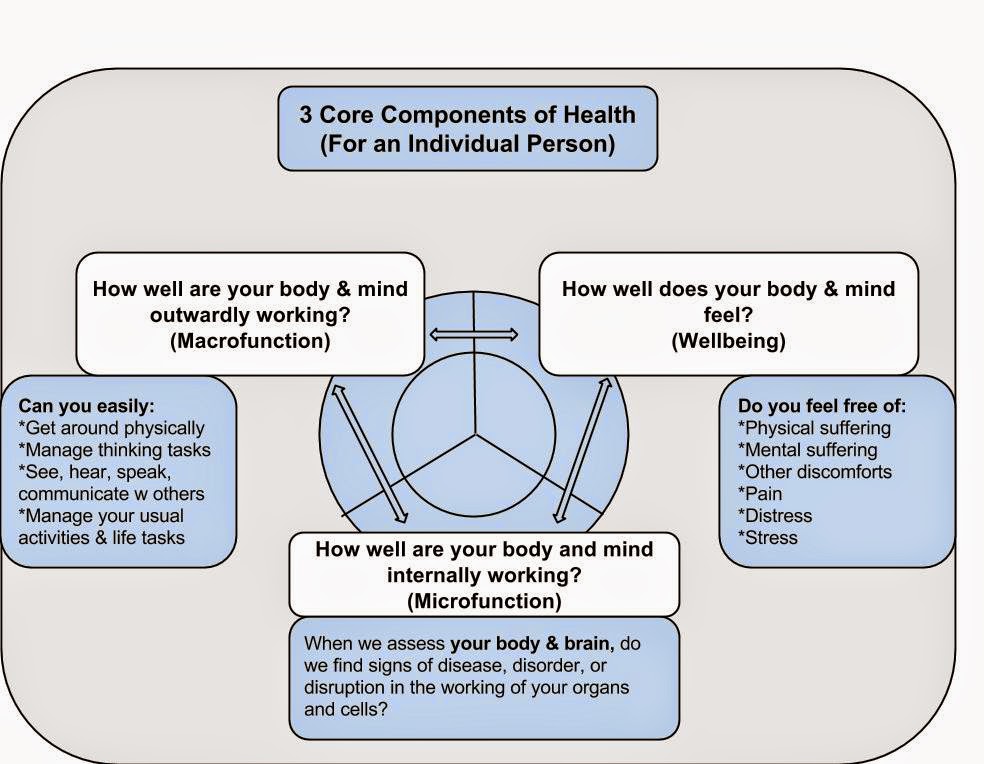
Health is a dynamic state. For an individual, it involves three core components:

  • How are you feeling? How do your body and mind feel? Are you experiencing any pain? Bothersome sensations? Mental distress? This component of health addresses the individual’s experience of suffering. 
  • How well are your body and mind outwardly working? Are your body and mind working as you expect them to, or need them to, or want them to? Can you get around physically as you usually do? Can you manage your thinking tasks? Can you see, hear, speak, and otherwise communicate effectively with others? This component addresses the individual’s ability to leverage body and mind in order to manage one’s usual activities and life tasks. 
  • How well are your body and mind internally working? This component relates to one’s inner physiology and function. When we peer inside, whether with modern technology, via the careful pulse auscultation used in some cultures, or any other method, is anything awry? Do we find signs of disease, disorder, or disruption? In Western medicine, we consider the workings of organs and cells, but other cultures have their own “inner workings” that they assess when evaluating health.

These three components are in constant interplay with each other. Right now I’ll refer to them your wellbeing, your macrofunction, and your microfunction. (But I’m not sure those are best terms.)

These three components of health are also in constant interplay with our social and physical environments, as well as with our nutrition and our “lifestyle choices.” For instance, rich social encounters and purposeful work improve wellbeing, as well as immune function and other aspects of our microfunction. Air pollution might make us cough, and can negatively impact our lung function, along with other less visible parts of our health.

Are these many external factors, and our behavior choices, synonymous with “your health”? I would call them influences on your health, or in certain cases “health care”, rather than your health itself. (And they aren’t diagrammed above, although I’d like to add them eventually.) These factors are incredibly important, but we confuse matters when we conflate things that influence health — such as access to clinicians, clean water, walkable cities — with the actual health of an individual.

Why does a person’s health matter?

Better health is an important end in of itself.

But to a large extent, health is a means to a more important end: that of living life.

In other words, being able to do the things we care about, need to do, and want to do. Being able to do things that give purpose, meaning, and pleasure to our lives. Being able to do the things that make us feel like our selves.

This is kind of obvious, but it’s actually fairly easy to lose sight of this when we get immersed in the weeds of health and health care. (Which is why the Unmentionables at Health 2.0 is so fantastic: it’s a much-needed reminder that health serves life.)

[Caveat: There is a lot of overlap between the life activities, but I haven’t yet figured out how to diagram this. Graphic design is not my forte.]

What is a health problem?

As a doctor, my job is to help people address their health problems. And I’d like for the digital health entrepreneurs to create tools that work better for this purpose.

So what is a health problem? How to define what people seem to need help with? How to define what digital health tools should help us – whether we are a patient, a clinician, or a family caregiver – address?

Here is a practical definition: a health problem is anything that is “wrong” with one or more of the three components of health above.

For instance:

  • Wellbeing Problems: Examples include being in pain, being fatigued, having insomnia, feeling depressed, feeling anxious, feeling short of breath, and so forth. Many symptoms, pains, discomforts, and any other forms of suffering fall into this category.
  • Macrofunction Problems: These might include having difficulty walking due to arthritis, problems exercising due to shortness of breath, or problems thinking due to dementia. You could also include vision problems, hearing problems, and speech difficulties due to stroke. These issues often cause noticeable functional impairments.
  • Microfunction Problems: These would include problems such as having impaired glucose metabolism, high blood pressure, osteoporosis, kidney disease, as well as early stage cancer.

You’ll notice that problems with wellbeing and macrofunction are primarily person-defined. It’s the affected person – sometimes known as “the patient” – who experiences suffering, or difficulties in how the body and mind are working. Whereas microfunction problems are generally “expert-defined”: nobody knows they have osteoporosis until clinicians tell them.

Many diagnoses, diseases, or health stressors will cause problems in all three parts of health. For example, cancer symptoms and the related functional impairments (e.g. problems doing anything you can usually do) are the consequence of the cancer cells running amok within.

Congestive heart failure might cause uncomfortable dyspnea, as well decreased exercise tolerance, such that a person has difficulty managing usual ambulation and activities.

Of course, there is a lot of room to argue about what constitutes “wrong” with a given health component. Cultural and social factors influence how people perceive their own suffering, or overt impairments. And we could quibble endlessly about what is ideal blood pressure, and how we might otherwise assess how right or wrong a person’s body and mind are internally working.

Still, in many cases, if most of agree that something seems “wrong” with a given component of health, this should provide us with a decent practical starting point for identifying health problems.

Do we need to distinguish between microfunction and macrofunction?

I believe we do. Problems with macrofunction are the things that people notice in themselves (or in others, when it comes to cognitive macrodysfunction). These are what patients are often most concerned about.

Macrofunction problems, along with forms of suffering, are also what directly impacts people’s ability to participate in life tasks, and their short-term quality of life.

So helping people correct, mitigate, or adapt to these types of functional impairments is incredibly powerful, if you want to address health problems in a way that makes people’s lives materially better. This is an approach that is common in geriatrics, palliative care, physical and occupational therapy, and behavioral therapy.

Microfunction, on the other hand, is what people need technical assistance to assess. (Historically that assistance have been clinicians, but we’re on the cusp of seeing advanced diagnostic tools in the hands of the public.)

Much of the work that we doctors do in modern medicine, especially in primary care, is address physiologic problems that are scarcely perceptible to the affected person: high blood pressure, high cholesterol, type 2 diabetes, kidney disease, asymptomatic atrial fibrillation.

We do this work because we are trying to prevent or delay more overt health problems, such as those associated with suffering and macrodysfunction. So it’s certainly worthwhile work. But it doesn’t always feel satisfying or worthwhile to patients, especially if they are pre-occupied by other problems which are causing suffering or overt functional impairments.

In fact, it seems to be fairly common that patients and clinicians are focused on different aspects of health. A typical example: a doctor might decide to unilaterally prioritize tinkering with the microfunction, such as by prescribing more statins, even though a patient’s most pressing concern is falls or pain.

Feedback? Suggestions?

All models are wrong and incomplete, but some are useful, as the saying goes.

Is this model of health and health problems useful?

What do you like, and what do you think I absolutely should change?

[Many thanks to Leslie Salmon-Zhu of GraphicRecorders.com, for drawing a preliminary version of Three Components of Your Health graphic.]

Filed Under: Uncategorized

  • Go to page 1
  • Go to page 2
  • Go to page 3
  • Interim pages omitted …
  • Go to page 24
  • Go to Next Page »

Primary Sidebar

Get the ebook!

Follow @GeriTechBlog

Featured Posts

GeriTech’s Take on AARP’s 4th Health Innovation @50+ LivePitch

My Process for Meaningful Use & Chronic Care Management

Aging in Place Safely: Dr. K vs APS vs the latest start-up

Recent Posts

  • Smartwatches as Medical Alert Devices
  • Putting Older Adults at the Center of Technology Conversations
  • Using Technology to Balance Safety & Autonomy in Dementia
  • Notes from the Aging 2.0 Optimize 2017 Conference
  • Interview: Upcoming Aging 2.0 Optimize Conference & Important Problems in Need of Solutions

Archives

Footer

Creative Commons License
This work is licensed under a Creative Commons Attribution-NonCommercial-NoDerivs 3.0 Unported License.
Based on a work at geritech.org

Copyright © 2025 · Leslie Kernisan, MD MPH